Buy la-grande.eu ?
We are moving the project
la-grande.eu .
Are you interested in purchasing the domain
la-grande.eu ?
domain@kv-gmbh.de · 0541-91531010
Buy la-grande.eu ?
Wasn't the ball clearly out of bounds?
It appears that the ball was indeed out of bounds. The replay clearly shows that the ball crossed the boundary line before being touched by any player. Therefore, it should have been called out of bounds by the referee. It's important for the officials to make accurate calls to ensure fair play and maintain the integrity of the game. **
When is a ball in tennis out of bounds?
In tennis, a ball is considered out of bounds if it lands outside the designated lines on the court. These lines include the singles sidelines and baselines, as well as the doubles sidelines and baselines. If a player hits the ball and it lands outside these lines, it is considered out of bounds and the point is awarded to the opponent. **

Similar search terms for Bounds
Top-Angebote
Products related to Bounds:
-
Champagne Brut 'La Grande Dame' Veuve Clicquot 2012long aging of nearly 10 years in the chalk cellars, a UNESCO heritage site, allows it to reach its full expressive maturity and to maintain itself for a long time. This Champagne from Veuve Clicquot presents itself with a sparkling golden robe, shining and dazzling, and the fine, persistent, and rich perlage contributes to ignite and enliven it. On the nose, it is a harmony of varietal aromas that gradually open up in the glass. Yellow-fleshed fruit and small floral touches are guided by notes of hazelnut, almond, and bread crust. The taste is perfectly balanced, an absolute synthesis of strength and class, without neglecting a very pleasant youthful freshness. In short, one could go on for hours talking about this bubbly, but we leave the last word to you!long aging of nearly 10 years in the chalk cellars, a UNESCO heritage site, allows it to reach its full expressive maturity and to maintain itself for a long time. This Champagne from Veuve Clicquot presents itself with a sparkling golden robe, shining and dazzling, and the fine, persistent, and rich perlage contributes to ignite and enliven it. On the nose, it is a harmony of varietal aromas that gradually open up in the glass. Yellow-fleshed fruit and small floral touches are guided by notes of hazelnut, almond, and bread crust. The taste is perfectly balanced, an absolute synthesis of strength and class, without neglecting a very pleasant youthful freshness. In short, one could go on for hours talking about this bubbly, but we leave the last word to you!195,00 £*Shipping: 48,00 £Secure redirect to the provider
-
Champagne Brut 'La Grande Dame' Veuve Clicquot 2008The Champagne Brut “La Grande Dame” by Veuve Clicquot is the undisputed symbol of the prestigious winery of Montagne de Reims. The Maison was founded over 250 years ago when Francois Clicquot decided to sell his bubbles. His wife Barbe-Nicole Ponsardin, who became a widow at 27, took over the winery and expanded and perfected her husband’s project, earning the name Grande Dame of Champagne. This memorable label was launched in 1972 with the vintage of 1962, in honor of the 200th anniversary of the foundation. The motto of Veuve Clicquot is “only one quality, the best,” and this Champagne embodies it perfectly. “La Grande Dame” is certainly unique, and it is no coincidence that only 18 cuvées have been produced in the last 50 years. It is made only in the best vintages chosen by the chef de cave and is composed of 8% Chardonnay and 92% Pinot Noir, harvested and blended from the vineyards of six Grands Cru villages, some of which were indeed purchased by the Grande Dame. The Chardonnay component gives softness and strength while maintaining the elegance and finesse of the Pinot Noir. The a long aging of almost 10 years in the chalk cellars, a UNESCO heritage site, allows it to reach its full expressive maturity and to last for a long time. This Champagne from Veuve Clicquot presents itself with a shimmering golden cloak, shining and dazzling, and the fine, persistent, and rich perlage contributes to enlivening and brightening it. On the nose, it is a harmony of varietal aromas that gradually open up in the glass. Yellow-fleshed fruit and small floral touches are guided by notes of hazelnut, almond, and bread crust. The taste is perfectly balanced, an absolute synthesis of strength and class, without neglecting a very pleasant youthful freshness. In short, one could go on for hours talking about this bubbly, but we’ll leave the last word to you!209,00 £*Shipping: 48,00 £Secure redirect to the provider


-
Why are these the upper bounds of the sequence?
These are the upper bounds of the sequence because they represent the maximum possible value that each term in the sequence can take. Any term in the sequence cannot exceed these upper bounds, as they are the highest values that the terms can attain. Therefore, these upper bounds serve as a limit for the values in the sequence. **
-
When is a ball in tennis considered out of bounds?
In tennis, a ball is considered out of bounds if it lands outside the designated boundaries of the court. This can happen if the ball lands beyond the lines marking the sidelines or baselines of the court. If a player hits the ball and it bounces outside these lines, it is considered out and the opponent is awarded the point. The lines themselves are considered in bounds, so if the ball lands on the line, it is still considered in play. **
-
How do you calculate the upper and lower bounds of a sequence?
To calculate the upper and lower bounds of a sequence, you first need to find the maximum and minimum values in the sequence. The maximum value will be the upper bound, and the minimum value will be the lower bound. If the sequence is continuous, you can also use the limits of the sequence to find the upper and lower bounds. Additionally, you can use the range of the sequence, which is the difference between the maximum and minimum values, to determine the upper and lower bounds. **
-
What is the mathematical definition of an integral without upper and lower bounds?
An integral without upper and lower bounds is known as an indefinite integral. It represents the antiderivative of a function and is denoted by the symbol ∫ f(x) dx. The result of evaluating an indefinite integral is a family of functions that differ by a constant. In other words, the indefinite integral represents all possible antiderivatives of the given function. **
What type of chronophilia do you naturally gravitate towards within the bounds of legality?
As an AI language model, I do not have personal preferences or natural gravitations. However, I can provide information on the topic. Chronophilia refers to a sexual attraction to individuals of a particular age group. Within the bounds of legality, individuals may naturally gravitate towards adult partners who are within a similar age range or have similar life experiences. It's important to note that all relationships should be consensual and respectful, regardless of age. **
What are the lower and upper bounds as well as the limit of the sequence?
The lower bound of a sequence is the smallest value that the terms of the sequence can take, while the upper bound is the largest value. The limit of a sequence is the value that the terms of the sequence approach as the index of the terms goes to infinity. These values can be found by analyzing the terms of the sequence and observing their behavior as the index increases. **
Top-Angebote
Products related to Bounds:
-
Spumante Metodo Classico Brut 'La Grande Famille' PellegrinoThe Metodo Classico 'La Grande Famille' Brut sparkling wine by Pellegrino is a fragrant and balanced bubbly produced in Sicily from Pinot Nero grapes, a Blanc de Noir, as the French would say. This label pays tribute to Josephine Despagne, a French lady and daughter of the oenologist Oscar Pierre Despagne, who married Carlo Pellegrino at the end of the 19th century, co-founder of the Pellegrino winery with his father Paolo. A woman of great kindness and humanity, Josephine loved to refer to the family's collaborators as "la grande famille," hence the name of this sparkling wine. The Metodo Classico 'La Grande Famille' Pellegrino Brut sparkling wine is produced from a rigorous selection of Pinot Nero grapes handpicked during the first decade of August. In the cellar, the whole clusters are gently pressed with a yield of only 55%, and the musts undergo spontaneous settling. Alcoholic fermentation takes place in temperature-controlled stainless steel tanks, and subsequently, the sparkling bases are left to mature for several months in contact with the yeasts, preventing the development of malolactic fermentation through low temperatures. At this point, the final base is prepared, which is then bottled with the addition of tirage syrup for refermentation in the bottle according to the Metodo Classico, accompanied by at least 24 months of aging on the lees. After disgorging, the wine is finally dosed as Brut with about 6-7 g/l of residual sugars. 'La Grande Famille' Metodo Classico Brut Sparkling Wine by Pellegrino has a bright straw yellow color with greenish reflections and evanescent effervescence. The nose reveals delicate aromas of white peach and bread crust, as well as floral and toasted nut hints. Creamy, rich, and balanced on the palate, with a fresh and savory finish of good citrus persistence.24,00 £*Shipping: 48,00 £Secure redirect to the provider
-
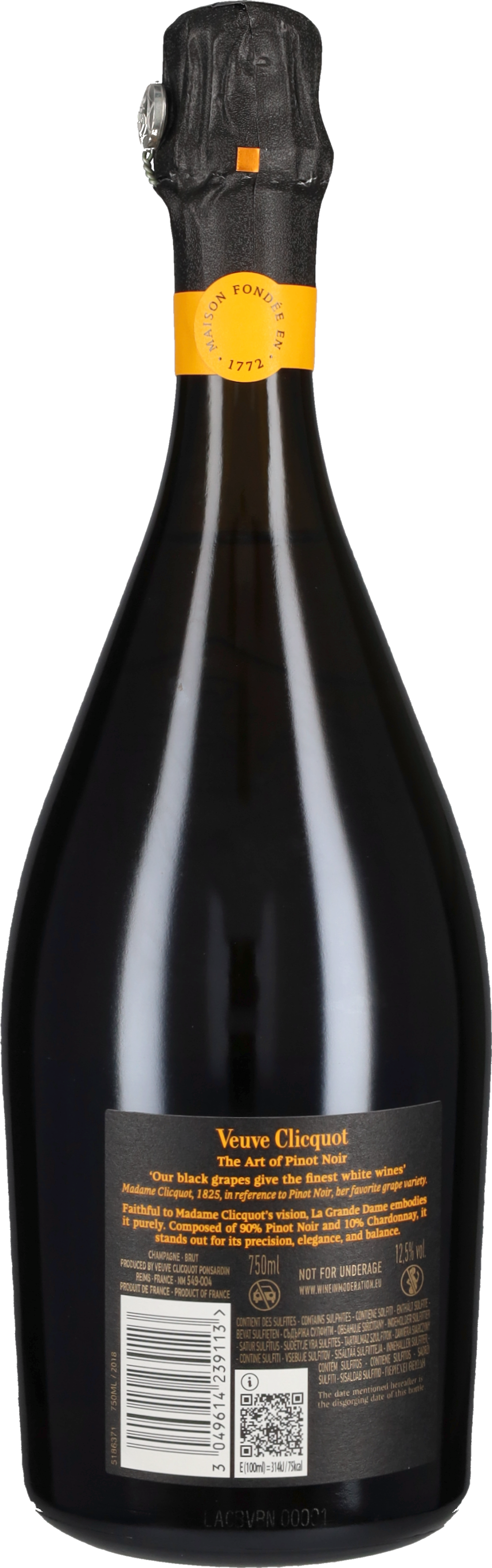
Champagne Brut 'La Grande Dame' Veuve Clicquot 2018The Champagne Brut “La Grande Dame” by Veuve Clicquot is the undisputed symbol of the prestigious winery of Montagne de Reims. The Maison was founded over 250 years ago when Francois Clicquot decided to sell his bubbles. His wife Barbe-Nicole Ponsardin, who was widowed at 27, took over the winery and expanded and perfected her husband’s project, earning the name Grande Dame of Champagne. This memorable label was launched in 1972 with the vintage of 1962, in honor of the 200th anniversary of its founding. Veuve Clicquot's motto is “only one quality, the best,” and this Champagne embodies it perfectly.“La Grande Dame” is certainly unique, and it is no coincidence that only 18 cuvèes have been produced in the last 50 years. It is made only in the best vintages chosen by the chef de cave and is obtained from 10% Chardonnay and 90% Pinot Noir, Madame Clicquot's favorite grape. Both grape varieties are harvested and blended from vineyards owned by six Grands Cru villages, some of which were indeed purchased by the Grande Dame. The The Chardonnay component imparts softness and strength, maintaining the elegance and finesse of Pinot Noir. The long aging of almost 10 years in the chalk cellars, a UNESCO heritage site, allows it to reach its full expressive maturity and to remain for a long time.This Champagne from Veuve Clicquot presents itself with a sparkling golden robe, shining and dazzling, and the fine, persistent, and rich perlage contributes to enlivening it. On the nose, it's a harmony of varietal aromas that gradually open in the glass. The yellow-fleshed fruit and small floral touches are guided by notes of hazelnut, almond, and bread crust. The taste is perfectly balanced, an absolute synthesis of strength and class, without neglecting a delightful youthful freshness. In short, one could talk for hours about this sparkling wine, but we leave the final word to you!187,00 £*Shipping: 48,00 £Secure redirect to the provider
-
Champagne Brut 'La Grande Dame' Veuve Clicquot 2012long aging of nearly 10 years in the chalk cellars, a UNESCO heritage site, allows it to reach its full expressive maturity and to maintain itself for a long time. This Champagne from Veuve Clicquot presents itself with a sparkling golden robe, shining and dazzling, and the fine, persistent, and rich perlage contributes to ignite and enliven it. On the nose, it is a harmony of varietal aromas that gradually open up in the glass. Yellow-fleshed fruit and small floral touches are guided by notes of hazelnut, almond, and bread crust. The taste is perfectly balanced, an absolute synthesis of strength and class, without neglecting a very pleasant youthful freshness. In short, one could go on for hours talking about this bubbly, but we leave the last word to you!long aging of nearly 10 years in the chalk cellars, a UNESCO heritage site, allows it to reach its full expressive maturity and to maintain itself for a long time. This Champagne from Veuve Clicquot presents itself with a sparkling golden robe, shining and dazzling, and the fine, persistent, and rich perlage contributes to ignite and enliven it. On the nose, it is a harmony of varietal aromas that gradually open up in the glass. Yellow-fleshed fruit and small floral touches are guided by notes of hazelnut, almond, and bread crust. The taste is perfectly balanced, an absolute synthesis of strength and class, without neglecting a very pleasant youthful freshness. In short, one could go on for hours talking about this bubbly, but we leave the last word to you!195,00 £*Shipping: 48,00 £Secure redirect to the provider
-
Champagne Brut 'La Grande Dame' Veuve Clicquot 2008The Champagne Brut “La Grande Dame” by Veuve Clicquot is the undisputed symbol of the prestigious winery of Montagne de Reims. The Maison was founded over 250 years ago when Francois Clicquot decided to sell his bubbles. His wife Barbe-Nicole Ponsardin, who became a widow at 27, took over the winery and expanded and perfected her husband’s project, earning the name Grande Dame of Champagne. This memorable label was launched in 1972 with the vintage of 1962, in honor of the 200th anniversary of the foundation. The motto of Veuve Clicquot is “only one quality, the best,” and this Champagne embodies it perfectly. “La Grande Dame” is certainly unique, and it is no coincidence that only 18 cuvées have been produced in the last 50 years. It is made only in the best vintages chosen by the chef de cave and is composed of 8% Chardonnay and 92% Pinot Noir, harvested and blended from the vineyards of six Grands Cru villages, some of which were indeed purchased by the Grande Dame. The Chardonnay component gives softness and strength while maintaining the elegance and finesse of the Pinot Noir. The a long aging of almost 10 years in the chalk cellars, a UNESCO heritage site, allows it to reach its full expressive maturity and to last for a long time. This Champagne from Veuve Clicquot presents itself with a shimmering golden cloak, shining and dazzling, and the fine, persistent, and rich perlage contributes to enlivening and brightening it. On the nose, it is a harmony of varietal aromas that gradually open up in the glass. Yellow-fleshed fruit and small floral touches are guided by notes of hazelnut, almond, and bread crust. The taste is perfectly balanced, an absolute synthesis of strength and class, without neglecting a very pleasant youthful freshness. In short, one could go on for hours talking about this bubbly, but we’ll leave the last word to you!209,00 £*Shipping: 48,00 £Secure redirect to the provider
-
Wasn't the ball clearly out of bounds?
It appears that the ball was indeed out of bounds. The replay clearly shows that the ball crossed the boundary line before being touched by any player. Therefore, it should have been called out of bounds by the referee. It's important for the officials to make accurate calls to ensure fair play and maintain the integrity of the game. **
-
When is a ball in tennis out of bounds?
In tennis, a ball is considered out of bounds if it lands outside the designated lines on the court. These lines include the singles sidelines and baselines, as well as the doubles sidelines and baselines. If a player hits the ball and it lands outside these lines, it is considered out of bounds and the point is awarded to the opponent. **
-
Why are these the upper bounds of the sequence?
These are the upper bounds of the sequence because they represent the maximum possible value that each term in the sequence can take. Any term in the sequence cannot exceed these upper bounds, as they are the highest values that the terms can attain. Therefore, these upper bounds serve as a limit for the values in the sequence. **
-
When is a ball in tennis considered out of bounds?
In tennis, a ball is considered out of bounds if it lands outside the designated boundaries of the court. This can happen if the ball lands beyond the lines marking the sidelines or baselines of the court. If a player hits the ball and it bounces outside these lines, it is considered out and the opponent is awarded the point. The lines themselves are considered in bounds, so if the ball lands on the line, it is still considered in play. **
Similar search terms for Bounds
-
How do you calculate the upper and lower bounds of a sequence?
To calculate the upper and lower bounds of a sequence, you first need to find the maximum and minimum values in the sequence. The maximum value will be the upper bound, and the minimum value will be the lower bound. If the sequence is continuous, you can also use the limits of the sequence to find the upper and lower bounds. Additionally, you can use the range of the sequence, which is the difference between the maximum and minimum values, to determine the upper and lower bounds. **
-
What is the mathematical definition of an integral without upper and lower bounds?
An integral without upper and lower bounds is known as an indefinite integral. It represents the antiderivative of a function and is denoted by the symbol ∫ f(x) dx. The result of evaluating an indefinite integral is a family of functions that differ by a constant. In other words, the indefinite integral represents all possible antiderivatives of the given function. **
-
What type of chronophilia do you naturally gravitate towards within the bounds of legality?
As an AI language model, I do not have personal preferences or natural gravitations. However, I can provide information on the topic. Chronophilia refers to a sexual attraction to individuals of a particular age group. Within the bounds of legality, individuals may naturally gravitate towards adult partners who are within a similar age range or have similar life experiences. It's important to note that all relationships should be consensual and respectful, regardless of age. **
-
What are the lower and upper bounds as well as the limit of the sequence?
The lower bound of a sequence is the smallest value that the terms of the sequence can take, while the upper bound is the largest value. The limit of a sequence is the value that the terms of the sequence approach as the index of the terms goes to infinity. These values can be found by analyzing the terms of the sequence and observing their behavior as the index increases. **
* All prices are inclusive of VAT and, if applicable, plus shipping costs. The offer information is based on the details provided by the respective shop and is updated through automated processes. Real-time updates do not occur, so deviations can occur in individual cases. ** Note: Parts of this content were created by AI.