Buy la-grande.eu ?
We are moving the project
la-grande.eu .
Are you interested in purchasing the domain
la-grande.eu ?
domain@kv-gmbh.de · 0541-91531010
Buy la-grande.eu ?
Why do iron-3 compounds occur more frequently in nature than iron-2 compounds?
Iron-3 compounds occur more frequently in nature than iron-2 compounds because iron has a natural tendency to oxidize and form iron-3 ions. This is due to the relative stability of the iron-3 oxidation state compared to the iron-2 oxidation state. Additionally, iron-3 compounds are more thermodynamically stable and are often formed through natural processes such as oxidation reactions in the presence of oxygen. As a result, iron-3 compounds are more commonly found in minerals, rocks, and biological systems in nature. **
How can one distinguish ionic compounds from molecular compounds?
Ionic compounds are formed from the attraction between positively and negatively charged ions, while molecular compounds are formed from the sharing of electrons between atoms. One way to distinguish between the two is to look at their chemical formulas. Ionic compounds typically consist of a metal and a nonmetal, while molecular compounds consist of nonmetals only. Additionally, ionic compounds tend to have higher melting and boiling points compared to molecular compounds due to their strong electrostatic attractions. Finally, conducting a simple solubility test can also help distinguish between the two types of compounds, as ionic compounds are often soluble in water while molecular compounds may not be. **

Similar search terms for Compounds
Top-Angebote
Products related to Compounds:
-
Champagne Brut 'La Grande Dame' Veuve Clicquot 2012long aging of nearly 10 years in the chalk cellars, a UNESCO heritage site, allows it to reach its full expressive maturity and to maintain itself for a long time. This Champagne from Veuve Clicquot presents itself with a sparkling golden robe, shining and dazzling, and the fine, persistent, and rich perlage contributes to ignite and enliven it. On the nose, it is a harmony of varietal aromas that gradually open up in the glass. Yellow-fleshed fruit and small floral touches are guided by notes of hazelnut, almond, and bread crust. The taste is perfectly balanced, an absolute synthesis of strength and class, without neglecting a very pleasant youthful freshness. In short, one could go on for hours talking about this bubbly, but we leave the last word to you!long aging of nearly 10 years in the chalk cellars, a UNESCO heritage site, allows it to reach its full expressive maturity and to maintain itself for a long time. This Champagne from Veuve Clicquot presents itself with a sparkling golden robe, shining and dazzling, and the fine, persistent, and rich perlage contributes to ignite and enliven it. On the nose, it is a harmony of varietal aromas that gradually open up in the glass. Yellow-fleshed fruit and small floral touches are guided by notes of hazelnut, almond, and bread crust. The taste is perfectly balanced, an absolute synthesis of strength and class, without neglecting a very pleasant youthful freshness. In short, one could go on for hours talking about this bubbly, but we leave the last word to you!195,00 £*Shipping: 48,00 £Secure redirect to the provider
-
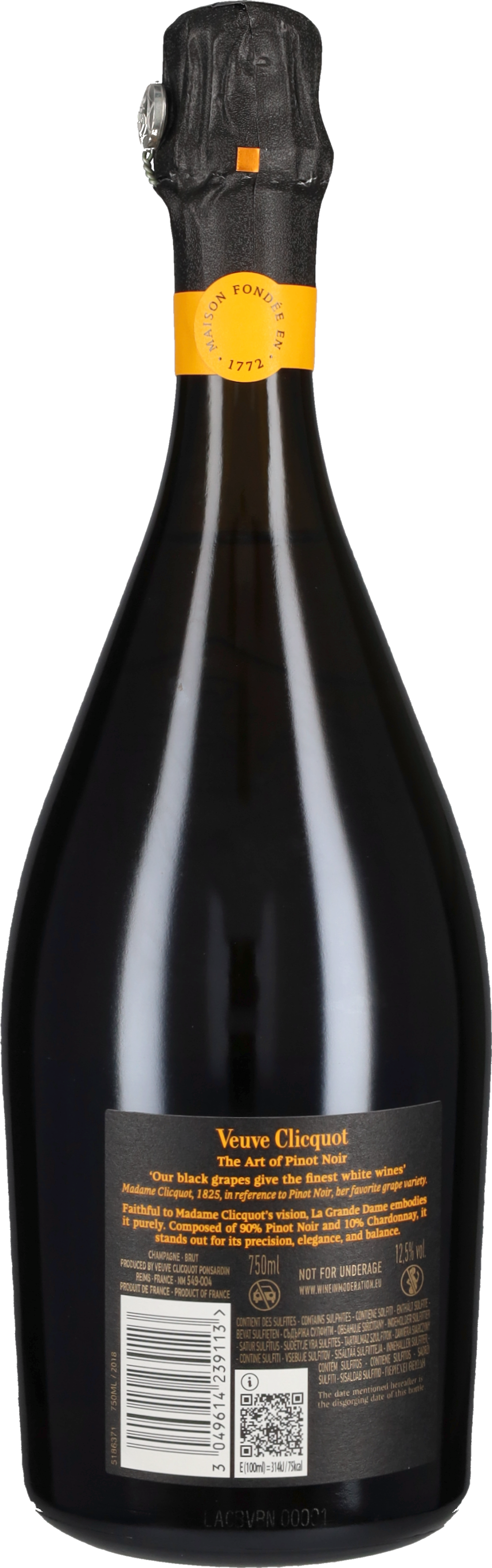
Champagne Brut 'La Grande Dame' Veuve Clicquot 2018The Champagne Brut “La Grande Dame” by Veuve Clicquot is the undisputed symbol of the prestigious winery of Montagne de Reims. The Maison was founded over 250 years ago when Francois Clicquot decided to sell his bubbles. His wife Barbe-Nicole Ponsardin, who was widowed at 27, took over the winery and expanded and perfected her husband’s project, earning the name Grande Dame of Champagne. This memorable label was launched in 1972 with the vintage of 1962, in honor of the 200th anniversary of its founding. Veuve Clicquot's motto is “only one quality, the best,” and this Champagne embodies it perfectly.“La Grande Dame” is certainly unique, and it is no coincidence that only 18 cuvèes have been produced in the last 50 years. It is made only in the best vintages chosen by the chef de cave and is obtained from 10% Chardonnay and 90% Pinot Noir, Madame Clicquot's favorite grape. Both grape varieties are harvested and blended from vineyards owned by six Grands Cru villages, some of which were indeed purchased by the Grande Dame. The The Chardonnay component imparts softness and strength, maintaining the elegance and finesse of Pinot Noir. The long aging of almost 10 years in the chalk cellars, a UNESCO heritage site, allows it to reach its full expressive maturity and to remain for a long time.This Champagne from Veuve Clicquot presents itself with a sparkling golden robe, shining and dazzling, and the fine, persistent, and rich perlage contributes to enlivening it. On the nose, it's a harmony of varietal aromas that gradually open in the glass. The yellow-fleshed fruit and small floral touches are guided by notes of hazelnut, almond, and bread crust. The taste is perfectly balanced, an absolute synthesis of strength and class, without neglecting a delightful youthful freshness. In short, one could talk for hours about this sparkling wine, but we leave the final word to you!187,00 £*Shipping: 48,00 £Secure redirect to the provider
-
Champagne Brut 'La Grande Dame' Veuve Clicquot 2008The Champagne Brut “La Grande Dame” by Veuve Clicquot is the undisputed symbol of the prestigious winery of Montagne de Reims. The Maison was founded over 250 years ago when Francois Clicquot decided to sell his bubbles. His wife Barbe-Nicole Ponsardin, who became a widow at 27, took over the winery and expanded and perfected her husband’s project, earning the name Grande Dame of Champagne. This memorable label was launched in 1972 with the vintage of 1962, in honor of the 200th anniversary of the foundation. The motto of Veuve Clicquot is “only one quality, the best,” and this Champagne embodies it perfectly. “La Grande Dame” is certainly unique, and it is no coincidence that only 18 cuvées have been produced in the last 50 years. It is made only in the best vintages chosen by the chef de cave and is composed of 8% Chardonnay and 92% Pinot Noir, harvested and blended from the vineyards of six Grands Cru villages, some of which were indeed purchased by the Grande Dame. The Chardonnay component gives softness and strength while maintaining the elegance and finesse of the Pinot Noir. The a long aging of almost 10 years in the chalk cellars, a UNESCO heritage site, allows it to reach its full expressive maturity and to last for a long time. This Champagne from Veuve Clicquot presents itself with a shimmering golden cloak, shining and dazzling, and the fine, persistent, and rich perlage contributes to enlivening and brightening it. On the nose, it is a harmony of varietal aromas that gradually open up in the glass. Yellow-fleshed fruit and small floral touches are guided by notes of hazelnut, almond, and bread crust. The taste is perfectly balanced, an absolute synthesis of strength and class, without neglecting a very pleasant youthful freshness. In short, one could go on for hours talking about this bubbly, but we’ll leave the last word to you!209,00 £*Shipping: 48,00 £Secure redirect to the provider
-
Spumante Metodo Classico Brut 'La Grande Famille' PellegrinoThe Metodo Classico 'La Grande Famille' Brut sparkling wine by Pellegrino is a fragrant and balanced bubbly produced in Sicily from Pinot Nero grapes, a Blanc de Noir, as the French would say. This label pays tribute to Josephine Despagne, a French lady and daughter of the oenologist Oscar Pierre Despagne, who married Carlo Pellegrino at the end of the 19th century, co-founder of the Pellegrino winery with his father Paolo. A woman of great kindness and humanity, Josephine loved to refer to the family's collaborators as "la grande famille," hence the name of this sparkling wine. The Metodo Classico 'La Grande Famille' Pellegrino Brut sparkling wine is produced from a rigorous selection of Pinot Nero grapes handpicked during the first decade of August. In the cellar, the whole clusters are gently pressed with a yield of only 55%, and the musts undergo spontaneous settling. Alcoholic fermentation takes place in temperature-controlled stainless steel tanks, and subsequently, the sparkling bases are left to mature for several months in contact with the yeasts, preventing the development of malolactic fermentation through low temperatures. At this point, the final base is prepared, which is then bottled with the addition of tirage syrup for refermentation in the bottle according to the Metodo Classico, accompanied by at least 24 months of aging on the lees. After disgorging, the wine is finally dosed as Brut with about 6-7 g/l of residual sugars. 'La Grande Famille' Metodo Classico Brut Sparkling Wine by Pellegrino has a bright straw yellow color with greenish reflections and evanescent effervescence. The nose reveals delicate aromas of white peach and bread crust, as well as floral and toasted nut hints. Creamy, rich, and balanced on the palate, with a fresh and savory finish of good citrus persistence.24,00 £*Shipping: 48,00 £Secure redirect to the provider



-
How do you distinguish determinative compounds and possessive compounds?
Determinative compounds are formed by combining two words to create a new concept, where the first word determines the meaning of the second word. For example, "blackboard" is a determinative compound where "black" determines the type of "board." Possessive compounds, on the other hand, indicate possession or relationship between the two words. For example, "John's car" is a possessive compound where "John" possesses the "car." In summary, determinative compounds determine the meaning of the second word, while possessive compounds indicate possession or relationship between the two words. **
-
Can you help me with chemistry? I need information about atomic compounds, metal compounds, and ionic compounds.
Of course! Atomic compounds are formed when two or more non-metal atoms are chemically bonded together, such as in molecules like water (H2O) and carbon dioxide (CO2). Metal compounds are formed when a metal atom is bonded to one or more non-metal atoms, such as in compounds like sodium chloride (NaCl) and iron oxide (Fe2O3). Ionic compounds are formed when a metal atom transfers one or more electrons to a non-metal atom, resulting in the formation of positively and negatively charged ions that are attracted to each other, such as in compounds like sodium chloride (NaCl) and calcium carbonate (CaCO3). Let me know if you need more specific information or examples! **
-
Why do molecular compounds have lower boiling points than ionic compounds?
Molecular compounds have lower boiling points than ionic compounds because the intermolecular forces holding the molecules together are generally weaker than the electrostatic forces holding ions together in ionic compounds. In molecular compounds, the intermolecular forces are typically van der Waals forces, dipole-dipole interactions, or hydrogen bonding, which are weaker than the strong ionic bonds in ionic compounds. As a result, less energy is required to overcome these weaker intermolecular forces, leading to lower boiling points for molecular compounds compared to ionic compounds. **
-
What are sodium compounds?
Sodium compounds are chemical compounds that contain sodium as one of their elements. These compounds can be found in various forms, such as sodium chloride (table salt), sodium hydroxide (lye), and sodium bicarbonate (baking soda). Sodium compounds are widely used in industry, agriculture, and everyday life due to their diverse properties and applications. **


Name the isomeric compounds.
Isomers are compounds that have the same molecular formula but different structural arrangements. Some examples of isomeric compounds include butane and isobutane, which both have the molecular formula C4H10 but differ in their structural arrangement. Another example is glucose and fructose, which both have the molecular formula C6H12O6 but have different structural arrangements and properties. **
What are atomic compounds?
Atomic compounds are chemical compounds that are composed of individual atoms of different elements bonded together. These compounds are held together by chemical bonds, such as ionic or covalent bonds, and do not contain any molecules. Examples of atomic compounds include sodium chloride (NaCl) and water (H2O). Unlike molecular compounds, which are made up of molecules, atomic compounds are made up of individual atoms. **
Top-Angebote
Products related to Compounds:
-
Character Options Cra-Z-Slimy Foodie Fun Shops Slimy Sweet Bakery Slime Playset - 6 Compounds - Ages 3 and UpCreate colourful bakery-inspired slime treats with the Cra-Z-Slimy Foodie Fun Shops Slimy Sweet Bakery Slime Playset. This hands-on activity set combines moulding, decorating, and squishing for a creative sensory play session. Children can use the included compounds, tools, moulds, and toppings to make pretend sweet creations such as doughnuts and cupcakes, then reshape the materials for another round of play. The set is designed around a playful bakery theme, encouraging imaginative ideas and tactile exploration. The compounds can be kept in an airtight container after play to help maintain their soft, stretchy texture for reuse. This playset includes 6 compounds, moulds, tools, and toppings for making and decorating pretend sweet treats, such as doughnuts and cupcakes.8,09 £*Shipping: 3,95 £Secure redirect to the provider
-
Champagne Brut 'La Grande Dame' Veuve Clicquot 2012long aging of nearly 10 years in the chalk cellars, a UNESCO heritage site, allows it to reach its full expressive maturity and to maintain itself for a long time. This Champagne from Veuve Clicquot presents itself with a sparkling golden robe, shining and dazzling, and the fine, persistent, and rich perlage contributes to ignite and enliven it. On the nose, it is a harmony of varietal aromas that gradually open up in the glass. Yellow-fleshed fruit and small floral touches are guided by notes of hazelnut, almond, and bread crust. The taste is perfectly balanced, an absolute synthesis of strength and class, without neglecting a very pleasant youthful freshness. In short, one could go on for hours talking about this bubbly, but we leave the last word to you!long aging of nearly 10 years in the chalk cellars, a UNESCO heritage site, allows it to reach its full expressive maturity and to maintain itself for a long time. This Champagne from Veuve Clicquot presents itself with a sparkling golden robe, shining and dazzling, and the fine, persistent, and rich perlage contributes to ignite and enliven it. On the nose, it is a harmony of varietal aromas that gradually open up in the glass. Yellow-fleshed fruit and small floral touches are guided by notes of hazelnut, almond, and bread crust. The taste is perfectly balanced, an absolute synthesis of strength and class, without neglecting a very pleasant youthful freshness. In short, one could go on for hours talking about this bubbly, but we leave the last word to you!195,00 £*Shipping: 48,00 £Secure redirect to the provider
-
Champagne Brut 'La Grande Dame' Veuve Clicquot 2018The Champagne Brut “La Grande Dame” by Veuve Clicquot is the undisputed symbol of the prestigious winery of Montagne de Reims. The Maison was founded over 250 years ago when Francois Clicquot decided to sell his bubbles. His wife Barbe-Nicole Ponsardin, who was widowed at 27, took over the winery and expanded and perfected her husband’s project, earning the name Grande Dame of Champagne. This memorable label was launched in 1972 with the vintage of 1962, in honor of the 200th anniversary of its founding. Veuve Clicquot's motto is “only one quality, the best,” and this Champagne embodies it perfectly.“La Grande Dame” is certainly unique, and it is no coincidence that only 18 cuvèes have been produced in the last 50 years. It is made only in the best vintages chosen by the chef de cave and is obtained from 10% Chardonnay and 90% Pinot Noir, Madame Clicquot's favorite grape. Both grape varieties are harvested and blended from vineyards owned by six Grands Cru villages, some of which were indeed purchased by the Grande Dame. The The Chardonnay component imparts softness and strength, maintaining the elegance and finesse of Pinot Noir. The long aging of almost 10 years in the chalk cellars, a UNESCO heritage site, allows it to reach its full expressive maturity and to remain for a long time.This Champagne from Veuve Clicquot presents itself with a sparkling golden robe, shining and dazzling, and the fine, persistent, and rich perlage contributes to enlivening it. On the nose, it's a harmony of varietal aromas that gradually open in the glass. The yellow-fleshed fruit and small floral touches are guided by notes of hazelnut, almond, and bread crust. The taste is perfectly balanced, an absolute synthesis of strength and class, without neglecting a delightful youthful freshness. In short, one could talk for hours about this sparkling wine, but we leave the final word to you!187,00 £*Shipping: 48,00 £Secure redirect to the provider
-
Why do iron-3 compounds occur more frequently in nature than iron-2 compounds?
Iron-3 compounds occur more frequently in nature than iron-2 compounds because iron has a natural tendency to oxidize and form iron-3 ions. This is due to the relative stability of the iron-3 oxidation state compared to the iron-2 oxidation state. Additionally, iron-3 compounds are more thermodynamically stable and are often formed through natural processes such as oxidation reactions in the presence of oxygen. As a result, iron-3 compounds are more commonly found in minerals, rocks, and biological systems in nature. **
-
How can one distinguish ionic compounds from molecular compounds?
Ionic compounds are formed from the attraction between positively and negatively charged ions, while molecular compounds are formed from the sharing of electrons between atoms. One way to distinguish between the two is to look at their chemical formulas. Ionic compounds typically consist of a metal and a nonmetal, while molecular compounds consist of nonmetals only. Additionally, ionic compounds tend to have higher melting and boiling points compared to molecular compounds due to their strong electrostatic attractions. Finally, conducting a simple solubility test can also help distinguish between the two types of compounds, as ionic compounds are often soluble in water while molecular compounds may not be. **
-
How do you distinguish determinative compounds and possessive compounds?
Determinative compounds are formed by combining two words to create a new concept, where the first word determines the meaning of the second word. For example, "blackboard" is a determinative compound where "black" determines the type of "board." Possessive compounds, on the other hand, indicate possession or relationship between the two words. For example, "John's car" is a possessive compound where "John" possesses the "car." In summary, determinative compounds determine the meaning of the second word, while possessive compounds indicate possession or relationship between the two words. **
-
Can you help me with chemistry? I need information about atomic compounds, metal compounds, and ionic compounds.
Of course! Atomic compounds are formed when two or more non-metal atoms are chemically bonded together, such as in molecules like water (H2O) and carbon dioxide (CO2). Metal compounds are formed when a metal atom is bonded to one or more non-metal atoms, such as in compounds like sodium chloride (NaCl) and iron oxide (Fe2O3). Ionic compounds are formed when a metal atom transfers one or more electrons to a non-metal atom, resulting in the formation of positively and negatively charged ions that are attracted to each other, such as in compounds like sodium chloride (NaCl) and calcium carbonate (CaCO3). Let me know if you need more specific information or examples! **
Similar search terms for Compounds
-
Champagne Brut 'La Grande Dame' Veuve Clicquot 2008The Champagne Brut “La Grande Dame” by Veuve Clicquot is the undisputed symbol of the prestigious winery of Montagne de Reims. The Maison was founded over 250 years ago when Francois Clicquot decided to sell his bubbles. His wife Barbe-Nicole Ponsardin, who became a widow at 27, took over the winery and expanded and perfected her husband’s project, earning the name Grande Dame of Champagne. This memorable label was launched in 1972 with the vintage of 1962, in honor of the 200th anniversary of the foundation. The motto of Veuve Clicquot is “only one quality, the best,” and this Champagne embodies it perfectly. “La Grande Dame” is certainly unique, and it is no coincidence that only 18 cuvées have been produced in the last 50 years. It is made only in the best vintages chosen by the chef de cave and is composed of 8% Chardonnay and 92% Pinot Noir, harvested and blended from the vineyards of six Grands Cru villages, some of which were indeed purchased by the Grande Dame. The Chardonnay component gives softness and strength while maintaining the elegance and finesse of the Pinot Noir. The a long aging of almost 10 years in the chalk cellars, a UNESCO heritage site, allows it to reach its full expressive maturity and to last for a long time. This Champagne from Veuve Clicquot presents itself with a shimmering golden cloak, shining and dazzling, and the fine, persistent, and rich perlage contributes to enlivening and brightening it. On the nose, it is a harmony of varietal aromas that gradually open up in the glass. Yellow-fleshed fruit and small floral touches are guided by notes of hazelnut, almond, and bread crust. The taste is perfectly balanced, an absolute synthesis of strength and class, without neglecting a very pleasant youthful freshness. In short, one could go on for hours talking about this bubbly, but we’ll leave the last word to you!209,00 £*Shipping: 48,00 £Secure redirect to the provider
-
Spumante Metodo Classico Brut 'La Grande Famille' PellegrinoThe Metodo Classico 'La Grande Famille' Brut sparkling wine by Pellegrino is a fragrant and balanced bubbly produced in Sicily from Pinot Nero grapes, a Blanc de Noir, as the French would say. This label pays tribute to Josephine Despagne, a French lady and daughter of the oenologist Oscar Pierre Despagne, who married Carlo Pellegrino at the end of the 19th century, co-founder of the Pellegrino winery with his father Paolo. A woman of great kindness and humanity, Josephine loved to refer to the family's collaborators as "la grande famille," hence the name of this sparkling wine. The Metodo Classico 'La Grande Famille' Pellegrino Brut sparkling wine is produced from a rigorous selection of Pinot Nero grapes handpicked during the first decade of August. In the cellar, the whole clusters are gently pressed with a yield of only 55%, and the musts undergo spontaneous settling. Alcoholic fermentation takes place in temperature-controlled stainless steel tanks, and subsequently, the sparkling bases are left to mature for several months in contact with the yeasts, preventing the development of malolactic fermentation through low temperatures. At this point, the final base is prepared, which is then bottled with the addition of tirage syrup for refermentation in the bottle according to the Metodo Classico, accompanied by at least 24 months of aging on the lees. After disgorging, the wine is finally dosed as Brut with about 6-7 g/l of residual sugars. 'La Grande Famille' Metodo Classico Brut Sparkling Wine by Pellegrino has a bright straw yellow color with greenish reflections and evanescent effervescence. The nose reveals delicate aromas of white peach and bread crust, as well as floral and toasted nut hints. Creamy, rich, and balanced on the palate, with a fresh and savory finish of good citrus persistence.24,00 £*Shipping: 48,00 £Secure redirect to the provider
-
Walker Books UK Ltd The Great Outdoors 10 Picture Books Collection Set Nature, Trees, Wildlife, Farm, Camping & Adventure Stories for ChildrenThe Great Outdoors: 10 Wild and Wonderful Picture Books Collection Set Ignite a love of nature and outdoor adventure with The Great Outdoors – 10 Wild and Wonderful Picture Books Collection Set.This beautifully illustrated bundle introduces children to the magic of trees, farms, forests, wildlife, camping, seashores, and the joy of exploring the world around them. Packed with heartwarming stories, gentle messages, and rich nature themes, these books encourage imagination, curiosity, and a lifelong appreciation for the outdoors.Perfect for bedtime reading, early learning, classroom storytime, or little explorers who love adventure. Ideal for ages 3–7, preschoolers, nursery settings, and early readers. Titles in this Set: 1. The Things That I Love About Trees 2. The Tree 3. Sally and the Limpet 4. Anywhere Farm 5. When We Go Camping 6. A Secret Worth Sharing 7. Lets Go To The Farm! 8. Yucky Worms 9. My Green Day 10. Sam Who Went to Sea The Things That I Love About Trees A very young non-fiction picture book that looks at how a tree changes with the seasons, with charming illustrations by Charlotte Voake.Learn how a plum tree changes with the seasons in this charming... The Tree A delightful picture book with a wonderful twist which encourages young children to think about the way animals and humans live side by side.The tree. Home to a family of birds in their nest, squirrels... Sally and the Limpet When Sally pulls a limpet off a rock at the beach, it sticks to her finger – and nothing she, her family or her friends do can unstick it. Sally's teacher says that limpets live on the same rock for twenty years. So will Sally ever get the limpet off her finger? Anywhere Farm For an anywhere farm, here's all that you need: soil and sunshine, some water, a seed. When We Go Camping When we go camping, we bang in the pegs, Bang in the pegs, bang in the pegs. Guy ropes are tricky; they trip up your legs! A Secret Worth Sharing Mole's new friend, Mouse, is so special, he doesn't want to share her with anyone and decides to keep her secret. but some secrets are worth sharing. Lets Go To The Farm Let's go to the farm with Billy and Bee! There's SO much to do, and SO much to see! Baby lambs and guinea pigs, and chickens on the run, Let's get your wellies on and join in all the fun! Yucky Worms You can't be FREINDS with an earthworm... You can't even tell WHICH end is which! Or CAN you My Green Day Here are ten things we can all do to make every day a green day. Sam Who Went to Sea Sam, the river rat, dreams of going to sea. Day and night, whatever he is doing, his thoughts turn seawards.12,90 £*Shipping: 2,99 £Secure redirect to the provider
-
Why do molecular compounds have lower boiling points than ionic compounds?
Molecular compounds have lower boiling points than ionic compounds because the intermolecular forces holding the molecules together are generally weaker than the electrostatic forces holding ions together in ionic compounds. In molecular compounds, the intermolecular forces are typically van der Waals forces, dipole-dipole interactions, or hydrogen bonding, which are weaker than the strong ionic bonds in ionic compounds. As a result, less energy is required to overcome these weaker intermolecular forces, leading to lower boiling points for molecular compounds compared to ionic compounds. **
-
What are sodium compounds?
Sodium compounds are chemical compounds that contain sodium as one of their elements. These compounds can be found in various forms, such as sodium chloride (table salt), sodium hydroxide (lye), and sodium bicarbonate (baking soda). Sodium compounds are widely used in industry, agriculture, and everyday life due to their diverse properties and applications. **
-
Name the isomeric compounds.
Isomers are compounds that have the same molecular formula but different structural arrangements. Some examples of isomeric compounds include butane and isobutane, which both have the molecular formula C4H10 but differ in their structural arrangement. Another example is glucose and fructose, which both have the molecular formula C6H12O6 but have different structural arrangements and properties. **
-
What are atomic compounds?
Atomic compounds are chemical compounds that are composed of individual atoms of different elements bonded together. These compounds are held together by chemical bonds, such as ionic or covalent bonds, and do not contain any molecules. Examples of atomic compounds include sodium chloride (NaCl) and water (H2O). Unlike molecular compounds, which are made up of molecules, atomic compounds are made up of individual atoms. **
* All prices are inclusive of VAT and, if applicable, plus shipping costs. The offer information is based on the details provided by the respective shop and is updated through automated processes. Real-time updates do not occur, so deviations can occur in individual cases. ** Note: Parts of this content were created by AI.