Buy la-grande.eu ?
We are moving the project
la-grande.eu .
Are you interested in purchasing the domain
la-grande.eu ?
domain@kv-gmbh.de · 0541-91531010
Buy la-grande.eu ?
What does plasticity mean?
Plasticity refers to the brain's ability to change and adapt in response to new experiences, learning, or injury. It is the brain's capacity to reorganize its structure, function, and connections in order to optimize performance and recover from damage. Plasticity allows the brain to form new neural pathways, strengthen existing connections, and even compensate for lost functions. This ability is crucial for learning, memory, and recovery from brain injuries. **
What does plasticity mean in architecture?
Plasticity in architecture refers to the ability of a material or structure to be molded, shaped, or manipulated in various ways to create different forms and designs. It allows architects to experiment with different shapes, textures, and configurations, leading to innovative and dynamic architectural solutions. Plasticity in architecture also enables buildings to adapt to different functions, environments, and user needs, making them more versatile and responsive. **


Similar search terms for Plasticity
Top-Angebote
Products related to Plasticity:
-
Spumante Metodo Classico Brut 'La Grande Famille' PellegrinoThe Metodo Classico 'La Grande Famille' Brut sparkling wine by Pellegrino is a fragrant and balanced bubbly produced in Sicily from Pinot Nero grapes, a Blanc de Noir, as the French would say. This label pays tribute to Josephine Despagne, a French lady and daughter of the oenologist Oscar Pierre Despagne, who married Carlo Pellegrino at the end of the 19th century, co-founder of the Pellegrino winery with his father Paolo. A woman of great kindness and humanity, Josephine loved to refer to the family's collaborators as "la grande famille," hence the name of this sparkling wine. The Metodo Classico 'La Grande Famille' Pellegrino Brut sparkling wine is produced from a rigorous selection of Pinot Nero grapes handpicked during the first decade of August. In the cellar, the whole clusters are gently pressed with a yield of only 55%, and the musts undergo spontaneous settling. Alcoholic fermentation takes place in temperature-controlled stainless steel tanks, and subsequently, the sparkling bases are left to mature for several months in contact with the yeasts, preventing the development of malolactic fermentation through low temperatures. At this point, the final base is prepared, which is then bottled with the addition of tirage syrup for refermentation in the bottle according to the Metodo Classico, accompanied by at least 24 months of aging on the lees. After disgorging, the wine is finally dosed as Brut with about 6-7 g/l of residual sugars. 'La Grande Famille' Metodo Classico Brut Sparkling Wine by Pellegrino has a bright straw yellow color with greenish reflections and evanescent effervescence. The nose reveals delicate aromas of white peach and bread crust, as well as floral and toasted nut hints. Creamy, rich, and balanced on the palate, with a fresh and savory finish of good citrus persistence.24,00 £*Shipping: 48,00 £Secure redirect to the provider
-
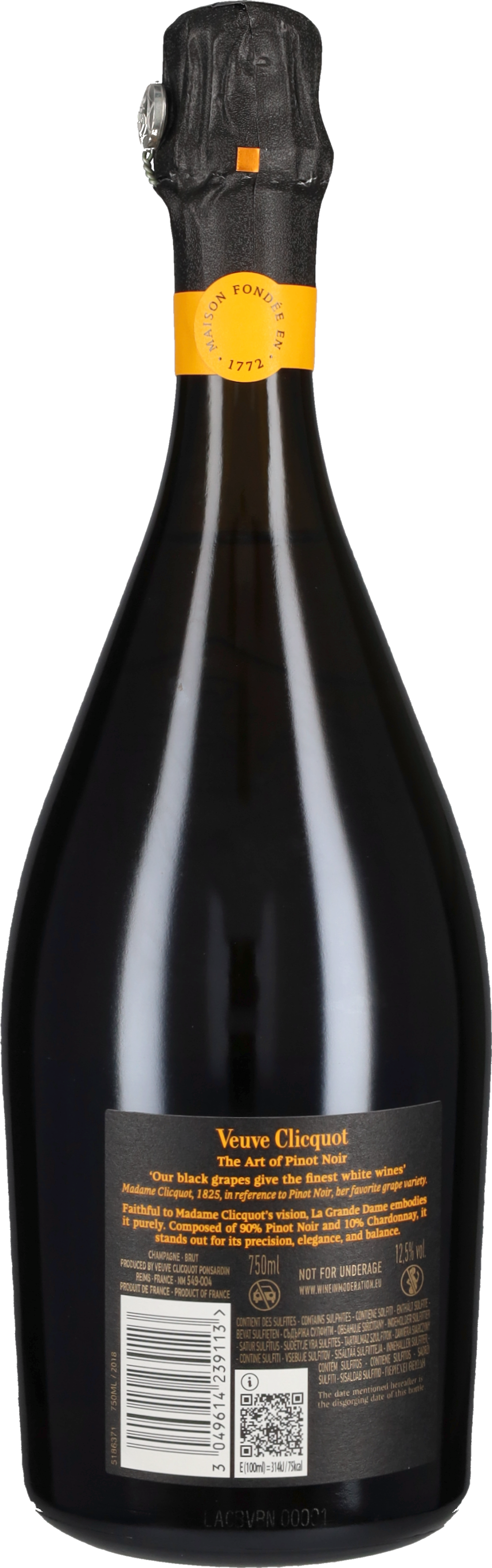
Champagne Brut 'La Grande Dame' Veuve Clicquot 2018The Champagne Brut “La Grande Dame” by Veuve Clicquot is the undisputed symbol of the prestigious winery of Montagne de Reims. The Maison was founded over 250 years ago when Francois Clicquot decided to sell his bubbles. His wife Barbe-Nicole Ponsardin, who was widowed at 27, took over the winery and expanded and perfected her husband’s project, earning the name Grande Dame of Champagne. This memorable label was launched in 1972 with the vintage of 1962, in honor of the 200th anniversary of its founding. Veuve Clicquot's motto is “only one quality, the best,” and this Champagne embodies it perfectly.“La Grande Dame” is certainly unique, and it is no coincidence that only 18 cuvèes have been produced in the last 50 years. It is made only in the best vintages chosen by the chef de cave and is obtained from 10% Chardonnay and 90% Pinot Noir, Madame Clicquot's favorite grape. Both grape varieties are harvested and blended from vineyards owned by six Grands Cru villages, some of which were indeed purchased by the Grande Dame. The The Chardonnay component imparts softness and strength, maintaining the elegance and finesse of Pinot Noir. The long aging of almost 10 years in the chalk cellars, a UNESCO heritage site, allows it to reach its full expressive maturity and to remain for a long time.This Champagne from Veuve Clicquot presents itself with a sparkling golden robe, shining and dazzling, and the fine, persistent, and rich perlage contributes to enlivening it. On the nose, it's a harmony of varietal aromas that gradually open in the glass. The yellow-fleshed fruit and small floral touches are guided by notes of hazelnut, almond, and bread crust. The taste is perfectly balanced, an absolute synthesis of strength and class, without neglecting a delightful youthful freshness. In short, one could talk for hours about this sparkling wine, but we leave the final word to you!187,00 £*Shipping: 48,00 £Secure redirect to the provider
-
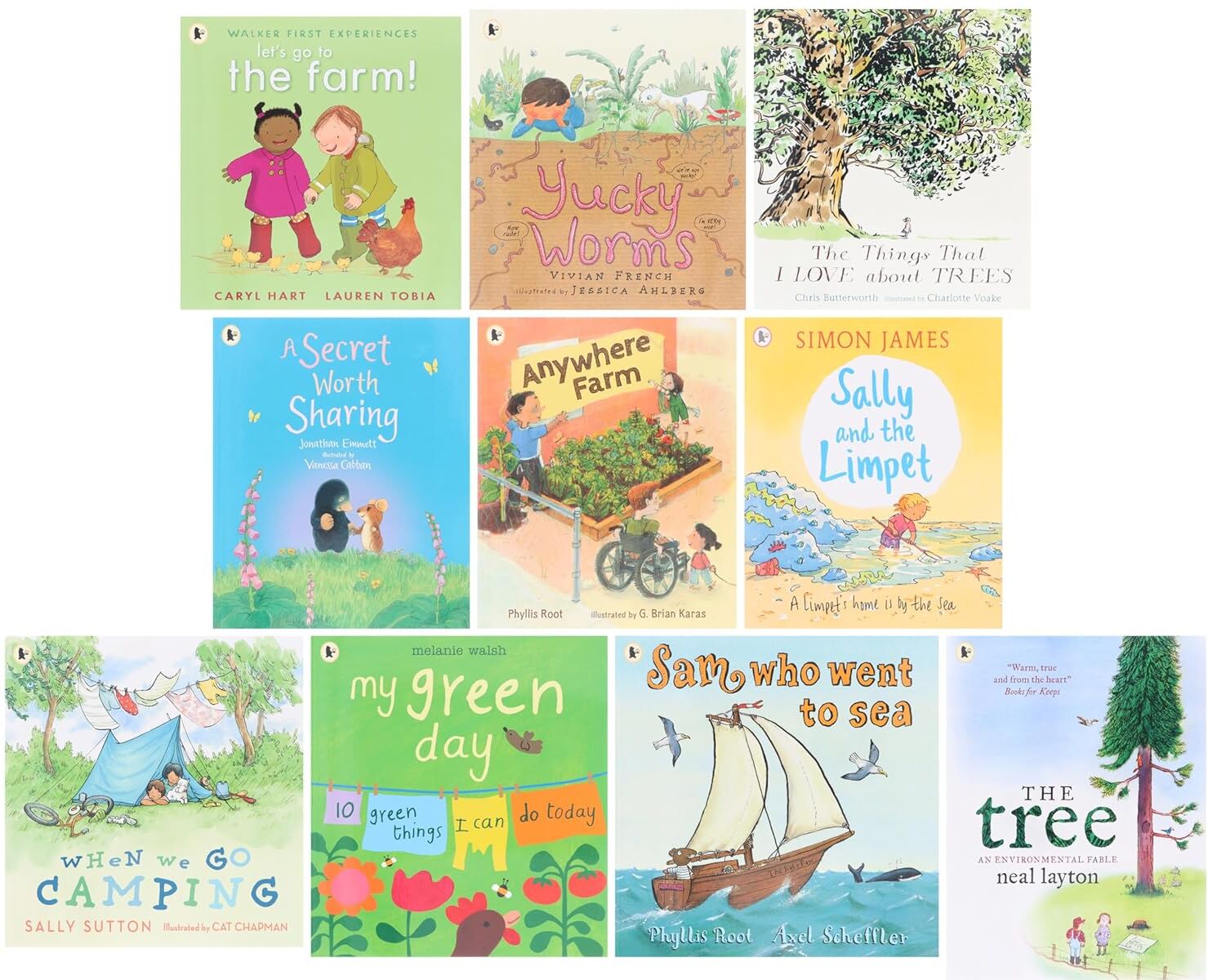
Walker Books UK Ltd The Great Outdoors 10 Picture Books Collection Set Nature, Trees, Wildlife, Farm, Camping & Adventure Stories for ChildrenThe Great Outdoors: 10 Wild and Wonderful Picture Books Collection Set Ignite a love of nature and outdoor adventure with The Great Outdoors – 10 Wild and Wonderful Picture Books Collection Set.This beautifully illustrated bundle introduces children to the magic of trees, farms, forests, wildlife, camping, seashores, and the joy of exploring the world around them. Packed with heartwarming stories, gentle messages, and rich nature themes, these books encourage imagination, curiosity, and a lifelong appreciation for the outdoors.Perfect for bedtime reading, early learning, classroom storytime, or little explorers who love adventure. Ideal for ages 3–7, preschoolers, nursery settings, and early readers. Titles in this Set: 1. The Things That I Love About Trees 2. The Tree 3. Sally and the Limpet 4. Anywhere Farm 5. When We Go Camping 6. A Secret Worth Sharing 7. Lets Go To The Farm! 8. Yucky Worms 9. My Green Day 10. Sam Who Went to Sea The Things That I Love About Trees A very young non-fiction picture book that looks at how a tree changes with the seasons, with charming illustrations by Charlotte Voake.Learn how a plum tree changes with the seasons in this charming... The Tree A delightful picture book with a wonderful twist which encourages young children to think about the way animals and humans live side by side.The tree. Home to a family of birds in their nest, squirrels... Sally and the Limpet When Sally pulls a limpet off a rock at the beach, it sticks to her finger – and nothing she, her family or her friends do can unstick it. Sally's teacher says that limpets live on the same rock for twenty years. So will Sally ever get the limpet off her finger? Anywhere Farm For an anywhere farm, here's all that you need: soil and sunshine, some water, a seed. When We Go Camping When we go camping, we bang in the pegs, Bang in the pegs, bang in the pegs. Guy ropes are tricky; they trip up your legs! A Secret Worth Sharing Mole's new friend, Mouse, is so special, he doesn't want to share her with anyone and decides to keep her secret. but some secrets are worth sharing. Lets Go To The Farm Let's go to the farm with Billy and Bee! There's SO much to do, and SO much to see! Baby lambs and guinea pigs, and chickens on the run, Let's get your wellies on and join in all the fun! Yucky Worms You can't be FREINDS with an earthworm... You can't even tell WHICH end is which! Or CAN you My Green Day Here are ten things we can all do to make every day a green day. Sam Who Went to Sea Sam, the river rat, dreams of going to sea. Day and night, whatever he is doing, his thoughts turn seawards.12,90 £*Shipping: 2,99 £Secure redirect to the provider
-
"""Bollinger La Grande Annee Brut Rose 2015 Champagne - France""""""Delicate pink reflections. A nose full of primary aromas, offering a delicious composition of fruit flavours, blending strawberry juice, mandarin and rhubarb. Silky, the prelude to a voluptuous, juicy wine. On the palate, stone fruits set the tone..."279,99 $*Shipping: 0,00 $Secure redirect to the provider

-
How can one represent plasticity without shimmering?
One way to represent plasticity without shimmering is to use matte finishes or textures that absorb light rather than reflect it. This can help create a more subtle and realistic representation of plasticity. Additionally, using soft and gradual transitions between colors or tones can help avoid the appearance of shimmering. Finally, paying attention to the lighting conditions and angles when capturing or rendering the plastic object can also help minimize shimmering and enhance the perception of plasticity. **
-
What is the spatial depth of plasticity?
The spatial depth of plasticity refers to the extent to which changes in the brain's structure and function occur as a result of learning or experience. It encompasses the range of brain regions and neural networks that are involved in the process of plasticity. This can include changes at the level of individual neurons, as well as larger-scale changes in connectivity and organization across different brain regions. The spatial depth of plasticity is important for understanding how the brain adapts to new information and experiences, and for developing interventions to promote healthy brain function. **
-
What is painted with plasticity in art?
In art, plasticity refers to the quality of being able to be molded or shaped. When something is painted with plasticity in art, it means that the artist has used techniques to create a sense of three-dimensionality, depth, and form in their work. This can be achieved through the use of light and shadow, texture, and the manipulation of the medium to create a sense of volume and movement in the artwork. Essentially, painting with plasticity allows the artist to create a sense of physical presence and depth in their work. **
-
What is the difference between spatiality and plasticity?
Spatiality refers to the physical dimensions and arrangement of objects or spaces in a given area, while plasticity refers to the ability of something to be molded, shaped, or changed. Spatiality is concerned with the actual layout and organization of physical elements, such as the distance between objects or the arrangement of rooms in a building. On the other hand, plasticity is about the flexibility and adaptability of a material or structure to be altered or reformed. In essence, spatiality deals with the existing physical space, while plasticity deals with the potential for change within that space. **


Why should IQ not be changeable if neural plasticity changes myelination and synaptic structure?
IQ should not be changeable simply because neural plasticity changes myelination and synaptic structure. While neural plasticity allows the brain to adapt and reorganize itself in response to learning and experiences, it does not necessarily result in a change in overall intelligence. IQ is a measure of a person's cognitive abilities and is influenced by a combination of genetic and environmental factors, which may not be easily altered through changes in neural plasticity alone. Additionally, IQ is a complex trait that is influenced by multiple factors beyond just neural plasticity, such as genetics, upbringing, and education. **
Why shouldn't IQ also be changeable if neural plasticity changes myelination and synaptic structure?
While neural plasticity does allow for changes in myelination and synaptic structure, it is important to note that IQ is a complex trait influenced by a combination of genetic and environmental factors. While it is true that the brain can change and adapt, there are limits to how much an individual's IQ can be altered. Additionally, IQ is a measure of cognitive abilities and is influenced by a wide range of factors beyond just neural plasticity, including genetics, early childhood experiences, and education. Therefore, while neural plasticity can certainly impact cognitive abilities, it is not the sole determinant of IQ and its changeability. **
Top-Angebote
Products related to Plasticity:
-
Champagne Brut 'La Grande Dame' Veuve Clicquot 2012long aging of nearly 10 years in the chalk cellars, a UNESCO heritage site, allows it to reach its full expressive maturity and to maintain itself for a long time. This Champagne from Veuve Clicquot presents itself with a sparkling golden robe, shining and dazzling, and the fine, persistent, and rich perlage contributes to ignite and enliven it. On the nose, it is a harmony of varietal aromas that gradually open up in the glass. Yellow-fleshed fruit and small floral touches are guided by notes of hazelnut, almond, and bread crust. The taste is perfectly balanced, an absolute synthesis of strength and class, without neglecting a very pleasant youthful freshness. In short, one could go on for hours talking about this bubbly, but we leave the last word to you!long aging of nearly 10 years in the chalk cellars, a UNESCO heritage site, allows it to reach its full expressive maturity and to maintain itself for a long time. This Champagne from Veuve Clicquot presents itself with a sparkling golden robe, shining and dazzling, and the fine, persistent, and rich perlage contributes to ignite and enliven it. On the nose, it is a harmony of varietal aromas that gradually open up in the glass. Yellow-fleshed fruit and small floral touches are guided by notes of hazelnut, almond, and bread crust. The taste is perfectly balanced, an absolute synthesis of strength and class, without neglecting a very pleasant youthful freshness. In short, one could go on for hours talking about this bubbly, but we leave the last word to you!195,00 £*Shipping: 48,00 £Secure redirect to the provider
-
Champagne Brut 'La Grande Dame' Veuve Clicquot 2008The Champagne Brut “La Grande Dame” by Veuve Clicquot is the undisputed symbol of the prestigious winery of Montagne de Reims. The Maison was founded over 250 years ago when Francois Clicquot decided to sell his bubbles. His wife Barbe-Nicole Ponsardin, who became a widow at 27, took over the winery and expanded and perfected her husband’s project, earning the name Grande Dame of Champagne. This memorable label was launched in 1972 with the vintage of 1962, in honor of the 200th anniversary of the foundation. The motto of Veuve Clicquot is “only one quality, the best,” and this Champagne embodies it perfectly. “La Grande Dame” is certainly unique, and it is no coincidence that only 18 cuvées have been produced in the last 50 years. It is made only in the best vintages chosen by the chef de cave and is composed of 8% Chardonnay and 92% Pinot Noir, harvested and blended from the vineyards of six Grands Cru villages, some of which were indeed purchased by the Grande Dame. The Chardonnay component gives softness and strength while maintaining the elegance and finesse of the Pinot Noir. The a long aging of almost 10 years in the chalk cellars, a UNESCO heritage site, allows it to reach its full expressive maturity and to last for a long time. This Champagne from Veuve Clicquot presents itself with a shimmering golden cloak, shining and dazzling, and the fine, persistent, and rich perlage contributes to enlivening and brightening it. On the nose, it is a harmony of varietal aromas that gradually open up in the glass. Yellow-fleshed fruit and small floral touches are guided by notes of hazelnut, almond, and bread crust. The taste is perfectly balanced, an absolute synthesis of strength and class, without neglecting a very pleasant youthful freshness. In short, one could go on for hours talking about this bubbly, but we’ll leave the last word to you!209,00 £*Shipping: 48,00 £Secure redirect to the provider
-
Spumante Metodo Classico Brut 'La Grande Famille' PellegrinoThe Metodo Classico 'La Grande Famille' Brut sparkling wine by Pellegrino is a fragrant and balanced bubbly produced in Sicily from Pinot Nero grapes, a Blanc de Noir, as the French would say. This label pays tribute to Josephine Despagne, a French lady and daughter of the oenologist Oscar Pierre Despagne, who married Carlo Pellegrino at the end of the 19th century, co-founder of the Pellegrino winery with his father Paolo. A woman of great kindness and humanity, Josephine loved to refer to the family's collaborators as "la grande famille," hence the name of this sparkling wine. The Metodo Classico 'La Grande Famille' Pellegrino Brut sparkling wine is produced from a rigorous selection of Pinot Nero grapes handpicked during the first decade of August. In the cellar, the whole clusters are gently pressed with a yield of only 55%, and the musts undergo spontaneous settling. Alcoholic fermentation takes place in temperature-controlled stainless steel tanks, and subsequently, the sparkling bases are left to mature for several months in contact with the yeasts, preventing the development of malolactic fermentation through low temperatures. At this point, the final base is prepared, which is then bottled with the addition of tirage syrup for refermentation in the bottle according to the Metodo Classico, accompanied by at least 24 months of aging on the lees. After disgorging, the wine is finally dosed as Brut with about 6-7 g/l of residual sugars. 'La Grande Famille' Metodo Classico Brut Sparkling Wine by Pellegrino has a bright straw yellow color with greenish reflections and evanescent effervescence. The nose reveals delicate aromas of white peach and bread crust, as well as floral and toasted nut hints. Creamy, rich, and balanced on the palate, with a fresh and savory finish of good citrus persistence.24,00 £*Shipping: 48,00 £Secure redirect to the provider
-
Champagne Brut 'La Grande Dame' Veuve Clicquot 2018The Champagne Brut “La Grande Dame” by Veuve Clicquot is the undisputed symbol of the prestigious winery of Montagne de Reims. The Maison was founded over 250 years ago when Francois Clicquot decided to sell his bubbles. His wife Barbe-Nicole Ponsardin, who was widowed at 27, took over the winery and expanded and perfected her husband’s project, earning the name Grande Dame of Champagne. This memorable label was launched in 1972 with the vintage of 1962, in honor of the 200th anniversary of its founding. Veuve Clicquot's motto is “only one quality, the best,” and this Champagne embodies it perfectly.“La Grande Dame” is certainly unique, and it is no coincidence that only 18 cuvèes have been produced in the last 50 years. It is made only in the best vintages chosen by the chef de cave and is obtained from 10% Chardonnay and 90% Pinot Noir, Madame Clicquot's favorite grape. Both grape varieties are harvested and blended from vineyards owned by six Grands Cru villages, some of which were indeed purchased by the Grande Dame. The The Chardonnay component imparts softness and strength, maintaining the elegance and finesse of Pinot Noir. The long aging of almost 10 years in the chalk cellars, a UNESCO heritage site, allows it to reach its full expressive maturity and to remain for a long time.This Champagne from Veuve Clicquot presents itself with a sparkling golden robe, shining and dazzling, and the fine, persistent, and rich perlage contributes to enlivening it. On the nose, it's a harmony of varietal aromas that gradually open in the glass. The yellow-fleshed fruit and small floral touches are guided by notes of hazelnut, almond, and bread crust. The taste is perfectly balanced, an absolute synthesis of strength and class, without neglecting a delightful youthful freshness. In short, one could talk for hours about this sparkling wine, but we leave the final word to you!187,00 £*Shipping: 48,00 £Secure redirect to the provider
-
What does plasticity mean?
Plasticity refers to the brain's ability to change and adapt in response to new experiences, learning, or injury. It is the brain's capacity to reorganize its structure, function, and connections in order to optimize performance and recover from damage. Plasticity allows the brain to form new neural pathways, strengthen existing connections, and even compensate for lost functions. This ability is crucial for learning, memory, and recovery from brain injuries. **
-
What does plasticity mean in architecture?
Plasticity in architecture refers to the ability of a material or structure to be molded, shaped, or manipulated in various ways to create different forms and designs. It allows architects to experiment with different shapes, textures, and configurations, leading to innovative and dynamic architectural solutions. Plasticity in architecture also enables buildings to adapt to different functions, environments, and user needs, making them more versatile and responsive. **
-
How can one represent plasticity without shimmering?
One way to represent plasticity without shimmering is to use matte finishes or textures that absorb light rather than reflect it. This can help create a more subtle and realistic representation of plasticity. Additionally, using soft and gradual transitions between colors or tones can help avoid the appearance of shimmering. Finally, paying attention to the lighting conditions and angles when capturing or rendering the plastic object can also help minimize shimmering and enhance the perception of plasticity. **
-
What is the spatial depth of plasticity?
The spatial depth of plasticity refers to the extent to which changes in the brain's structure and function occur as a result of learning or experience. It encompasses the range of brain regions and neural networks that are involved in the process of plasticity. This can include changes at the level of individual neurons, as well as larger-scale changes in connectivity and organization across different brain regions. The spatial depth of plasticity is important for understanding how the brain adapts to new information and experiences, and for developing interventions to promote healthy brain function. **
Similar search terms for Plasticity
-
Walker Books UK Ltd The Great Outdoors 10 Picture Books Collection Set Nature, Trees, Wildlife, Farm, Camping & Adventure Stories for ChildrenThe Great Outdoors: 10 Wild and Wonderful Picture Books Collection Set Ignite a love of nature and outdoor adventure with The Great Outdoors – 10 Wild and Wonderful Picture Books Collection Set.This beautifully illustrated bundle introduces children to the magic of trees, farms, forests, wildlife, camping, seashores, and the joy of exploring the world around them. Packed with heartwarming stories, gentle messages, and rich nature themes, these books encourage imagination, curiosity, and a lifelong appreciation for the outdoors.Perfect for bedtime reading, early learning, classroom storytime, or little explorers who love adventure. Ideal for ages 3–7, preschoolers, nursery settings, and early readers. Titles in this Set: 1. The Things That I Love About Trees 2. The Tree 3. Sally and the Limpet 4. Anywhere Farm 5. When We Go Camping 6. A Secret Worth Sharing 7. Lets Go To The Farm! 8. Yucky Worms 9. My Green Day 10. Sam Who Went to Sea The Things That I Love About Trees A very young non-fiction picture book that looks at how a tree changes with the seasons, with charming illustrations by Charlotte Voake.Learn how a plum tree changes with the seasons in this charming... The Tree A delightful picture book with a wonderful twist which encourages young children to think about the way animals and humans live side by side.The tree. Home to a family of birds in their nest, squirrels... Sally and the Limpet When Sally pulls a limpet off a rock at the beach, it sticks to her finger – and nothing she, her family or her friends do can unstick it. Sally's teacher says that limpets live on the same rock for twenty years. So will Sally ever get the limpet off her finger? Anywhere Farm For an anywhere farm, here's all that you need: soil and sunshine, some water, a seed. When We Go Camping When we go camping, we bang in the pegs, Bang in the pegs, bang in the pegs. Guy ropes are tricky; they trip up your legs! A Secret Worth Sharing Mole's new friend, Mouse, is so special, he doesn't want to share her with anyone and decides to keep her secret. but some secrets are worth sharing. Lets Go To The Farm Let's go to the farm with Billy and Bee! There's SO much to do, and SO much to see! Baby lambs and guinea pigs, and chickens on the run, Let's get your wellies on and join in all the fun! Yucky Worms You can't be FREINDS with an earthworm... You can't even tell WHICH end is which! Or CAN you My Green Day Here are ten things we can all do to make every day a green day. Sam Who Went to Sea Sam, the river rat, dreams of going to sea. Day and night, whatever he is doing, his thoughts turn seawards.12,90 £*Shipping: 2,99 £Secure redirect to the provider
-
"""Bollinger La Grande Annee Brut Rose 2015 Champagne - France""""""Delicate pink reflections. A nose full of primary aromas, offering a delicious composition of fruit flavours, blending strawberry juice, mandarin and rhubarb. Silky, the prelude to a voluptuous, juicy wine. On the palate, stone fruits set the tone..."279,99 $*Shipping: 0,00 $Secure redirect to the provider
-
What is painted with plasticity in art?
In art, plasticity refers to the quality of being able to be molded or shaped. When something is painted with plasticity in art, it means that the artist has used techniques to create a sense of three-dimensionality, depth, and form in their work. This can be achieved through the use of light and shadow, texture, and the manipulation of the medium to create a sense of volume and movement in the artwork. Essentially, painting with plasticity allows the artist to create a sense of physical presence and depth in their work. **
-
What is the difference between spatiality and plasticity?
Spatiality refers to the physical dimensions and arrangement of objects or spaces in a given area, while plasticity refers to the ability of something to be molded, shaped, or changed. Spatiality is concerned with the actual layout and organization of physical elements, such as the distance between objects or the arrangement of rooms in a building. On the other hand, plasticity is about the flexibility and adaptability of a material or structure to be altered or reformed. In essence, spatiality deals with the existing physical space, while plasticity deals with the potential for change within that space. **
-
Why should IQ not be changeable if neural plasticity changes myelination and synaptic structure?
IQ should not be changeable simply because neural plasticity changes myelination and synaptic structure. While neural plasticity allows the brain to adapt and reorganize itself in response to learning and experiences, it does not necessarily result in a change in overall intelligence. IQ is a measure of a person's cognitive abilities and is influenced by a combination of genetic and environmental factors, which may not be easily altered through changes in neural plasticity alone. Additionally, IQ is a complex trait that is influenced by multiple factors beyond just neural plasticity, such as genetics, upbringing, and education. **
-
Why shouldn't IQ also be changeable if neural plasticity changes myelination and synaptic structure?
While neural plasticity does allow for changes in myelination and synaptic structure, it is important to note that IQ is a complex trait influenced by a combination of genetic and environmental factors. While it is true that the brain can change and adapt, there are limits to how much an individual's IQ can be altered. Additionally, IQ is a measure of cognitive abilities and is influenced by a wide range of factors beyond just neural plasticity, including genetics, early childhood experiences, and education. Therefore, while neural plasticity can certainly impact cognitive abilities, it is not the sole determinant of IQ and its changeability. **
* All prices are inclusive of VAT and, if applicable, plus shipping costs. The offer information is based on the details provided by the respective shop and is updated through automated processes. Real-time updates do not occur, so deviations can occur in individual cases. ** Note: Parts of this content were created by AI.