Buy la-grande.eu ?
We are moving the project
la-grande.eu .
Are you interested in purchasing the domain
la-grande.eu ?
domain@kv-gmbh.de · 0541-91531010
Buy la-grande.eu ?
Who discovered Uranus?
Uranus was discovered by the German-born British astronomer Sir William Herschel on March 13, 1781. Herschel initially thought he had discovered a comet, but further observations revealed that it was actually a new planet. This discovery expanded the known boundaries of the solar system and was a significant contribution to the field of astronomy. **
Is that already Uranus?
No, that is not Uranus. Uranus is the seventh planet from the Sun in our solar system, and it is not visible to the naked eye from Earth. If you are looking at a celestial object and wondering if it is Uranus, it is likely not, as it would require a telescope to see it. **
Similar search terms for Uranus
Top-Angebote
Products related to Uranus:
-
Wayland ltd Space Station Academy Series Collection 8 Books Set By Sally Spray (Destination Venus, Mercury, Earth, Mars, Jupiter, Saturn, Uranus and Neptune)Space Station Academy Series Collection 8 Books Set By Sally Spray (Destination Venus, Mercury, Earth, Mars, Jupiter, Saturn, Uranus and Neptune) Destination Venus: Join the Space Station Academy students on their expedition to Venus where they'll learn about the turbulent weather systems and discover pancake dome volcanoes on this rocky planet, all while bouncing around in space bubbles. Destination Mercury: Mercury where they'll explore giant craters, dodge meteorites and find out that they can jump three times higher on this planet than on Earth! Destination Earth: Earth where they'll whiz past volcanoes, mountains and waterfalls, learning about the planet's core layers, and how it spins on an axis. Destination Mars: The students are off on an expedition to Mars where they'll uncover clues about life on the planet, learn what makes Mars red, explore volcanoes and catch up with the Mars rover that roams the planet's crusty canyons. Destination Jupiter: Jupiter where they'll cruise moon craters on skateboards and discover why Jupiter is stripy and covered in spots. Destination Saturn: Saturn where they'll learn about the planet's stormy weather, how soot particles are turned into diamonds and how to draw the pebble shaped moons that orbit Saturn. Destination Uranus: Uranus where they'll test their strength, lifting rocks on moon Oberon, parachute off an icy cliff edge on moon Miranda, learn what makes the planet blue and catch a whiff of the gassy atmosphere. Destination Neptune: Neptune where they'll find out what gives the ice giant its blue colour, learn about the sparkling ocean of diamonds that may exist at Neptune's rock core and use their jetpacks to navigate around some exploding geysers.14,39 £*Shipping: 2,99 £Secure redirect to the provider
-
Spumante Metodo Classico Brut 'La Grande Famille' PellegrinoThe Metodo Classico 'La Grande Famille' Brut sparkling wine by Pellegrino is a fragrant and balanced bubbly produced in Sicily from Pinot Nero grapes, a Blanc de Noir, as the French would say. This label pays tribute to Josephine Despagne, a French lady and daughter of the oenologist Oscar Pierre Despagne, who married Carlo Pellegrino at the end of the 19th century, co-founder of the Pellegrino winery with his father Paolo. A woman of great kindness and humanity, Josephine loved to refer to the family's collaborators as "la grande famille," hence the name of this sparkling wine. The Metodo Classico 'La Grande Famille' Pellegrino Brut sparkling wine is produced from a rigorous selection of Pinot Nero grapes handpicked during the first decade of August. In the cellar, the whole clusters are gently pressed with a yield of only 55%, and the musts undergo spontaneous settling. Alcoholic fermentation takes place in temperature-controlled stainless steel tanks, and subsequently, the sparkling bases are left to mature for several months in contact with the yeasts, preventing the development of malolactic fermentation through low temperatures. At this point, the final base is prepared, which is then bottled with the addition of tirage syrup for refermentation in the bottle according to the Metodo Classico, accompanied by at least 24 months of aging on the lees. After disgorging, the wine is finally dosed as Brut with about 6-7 g/l of residual sugars. 'La Grande Famille' Metodo Classico Brut Sparkling Wine by Pellegrino has a bright straw yellow color with greenish reflections and evanescent effervescence. The nose reveals delicate aromas of white peach and bread crust, as well as floral and toasted nut hints. Creamy, rich, and balanced on the palate, with a fresh and savory finish of good citrus persistence.24,00 £*Shipping: 48,00 £Secure redirect to the provider
-
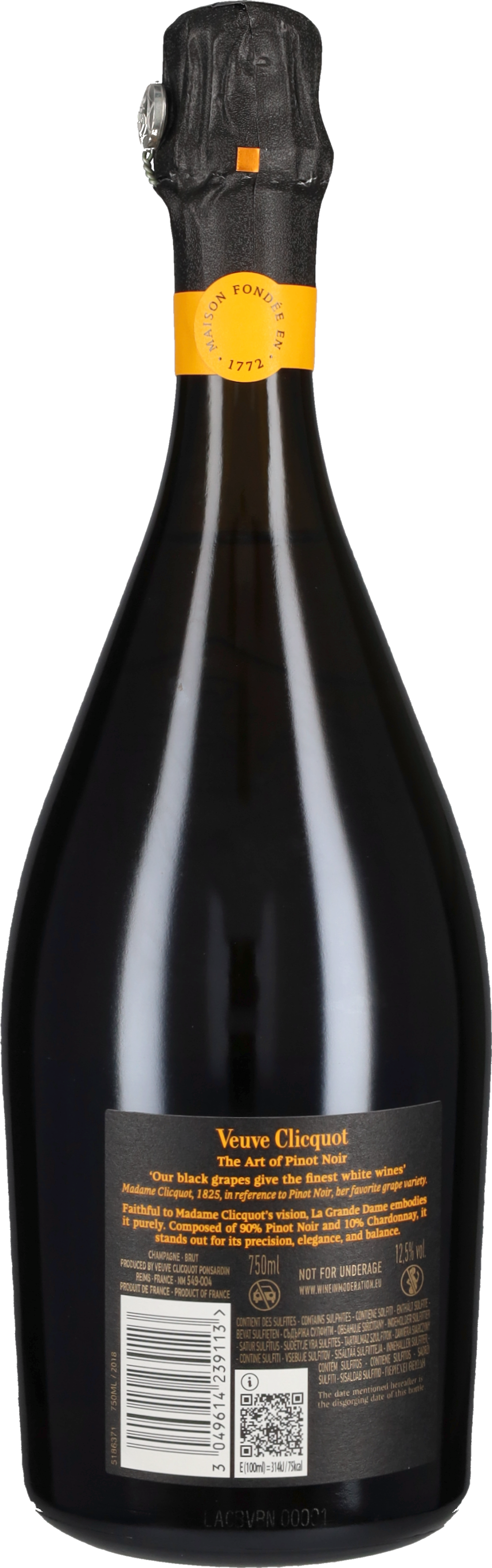
Champagne Brut 'La Grande Dame' Veuve Clicquot 2018The Champagne Brut “La Grande Dame” by Veuve Clicquot is the undisputed symbol of the prestigious winery of Montagne de Reims. The Maison was founded over 250 years ago when Francois Clicquot decided to sell his bubbles. His wife Barbe-Nicole Ponsardin, who was widowed at 27, took over the winery and expanded and perfected her husband’s project, earning the name Grande Dame of Champagne. This memorable label was launched in 1972 with the vintage of 1962, in honor of the 200th anniversary of its founding. Veuve Clicquot's motto is “only one quality, the best,” and this Champagne embodies it perfectly.“La Grande Dame” is certainly unique, and it is no coincidence that only 18 cuvèes have been produced in the last 50 years. It is made only in the best vintages chosen by the chef de cave and is obtained from 10% Chardonnay and 90% Pinot Noir, Madame Clicquot's favorite grape. Both grape varieties are harvested and blended from vineyards owned by six Grands Cru villages, some of which were indeed purchased by the Grande Dame. The The Chardonnay component imparts softness and strength, maintaining the elegance and finesse of Pinot Noir. The long aging of almost 10 years in the chalk cellars, a UNESCO heritage site, allows it to reach its full expressive maturity and to remain for a long time.This Champagne from Veuve Clicquot presents itself with a sparkling golden robe, shining and dazzling, and the fine, persistent, and rich perlage contributes to enlivening it. On the nose, it's a harmony of varietal aromas that gradually open in the glass. The yellow-fleshed fruit and small floral touches are guided by notes of hazelnut, almond, and bread crust. The taste is perfectly balanced, an absolute synthesis of strength and class, without neglecting a delightful youthful freshness. In short, one could talk for hours about this sparkling wine, but we leave the final word to you!187,00 £*Shipping: 48,00 £Secure redirect to the provider



-
Could that be Uranus?
Yes, it is possible that the object in question could be Uranus. Uranus is the seventh planet from the Sun and is visible to the naked eye under dark sky conditions. It has a distinct bluish-green color and can be identified by its unique appearance compared to other stars and planets. To confirm if the object is Uranus, one can use a star chart or a stargazing app to locate its position in the night sky. **
-
Does the planet Uranus stink?
Yes, the planet Uranus does have a distinct odor. The upper atmosphere of Uranus contains hydrogen sulfide, which gives the planet its characteristic rotten egg smell. This odor was confirmed by observations made by the Gemini North telescope in 2018. So, while we can't physically smell Uranus from Earth, scientists have determined that it does indeed stink. **
-
How many moons does Uranus have?
Uranus has 27 known moons. These moons are divided into three groups based on their characteristics: inner moons, major moons, and irregular moons. The largest moons of Uranus are named Titania and Oberon. **
-
What is the joke about Uranus?
The joke about Uranus is often a play on words, as the name of the planet sounds similar to the phrase "your anus." This leads to humorous puns and jokes about the pronunciation and spelling of the planet's name. It is a light-hearted and commonly used joke in popular culture and among those interested in astronomy. **


Could Uranus collide with our Earth?
The chances of Uranus colliding with Earth are extremely low. Uranus is located about 1.6 billion miles away from Earth, and the two planets follow different orbits around the Sun. The gravitational forces and vast distances between the two planets make a collision highly unlikely. Additionally, the orbits of the planets are stable and have been so for billions of years, making the likelihood of a collision even more remote. **
What is the model of Uranus?
Uranus is a gas giant planet, similar to Jupiter and Saturn. It has a thick atmosphere primarily composed of hydrogen and helium, with traces of methane. The planet has a unique feature in that its axis of rotation is tilted almost 90 degrees, causing it to essentially roll on its side as it orbits the Sun. This unusual tilt gives Uranus its distinct appearance and also leads to extreme seasonal variations on the planet. **
Top-Angebote
Products related to Uranus:
-
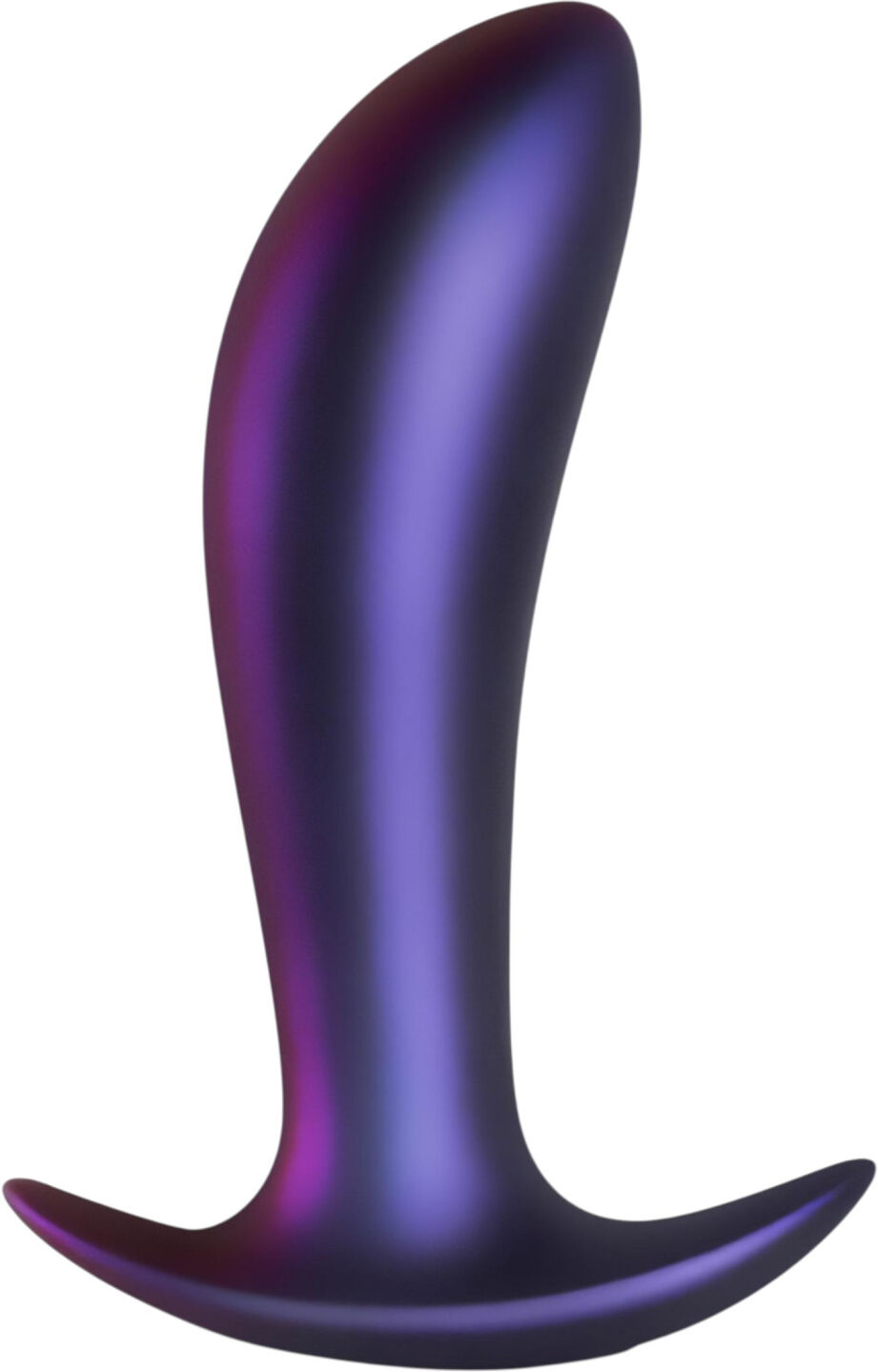
Hueman Uranus - Rechargeable Radio-Controlled Anal Vibrator (Purple)With an intergalactic design that offers intense anal pleasure, your partner can control your desires with the radio remote control! Why it's good?Unisex product - suitable for both women and menAnal vibrator and prostate massager in oneProvides intense massage, maintains prostate healthRigid base, skin-friendly, flexible materialAnatomically designed - narrow base for comfortBuilt-in battery - no need to worry about batteriesHighly flexible neck - ideal for circular prostate massageRadio, wireless remote control - easy control from a distance10 vibration modes - varying tingling sensationsFlared base - safe, won't slip inStrong motor - intense sensationsQuiet operation - discreet usePay attention to:Thoroughly clean before and after each useAlways use lubricant before insertionUse only water-based lubricant for lubricationThe product is only splash-proof, be careful not to get water on the electric parts during cleaningThe remote operates with a battery (CR2032), included in the controllerEnsure it does not come into contact with other items during storageUsage: Lubricate both the anal area and the anal vibrator evenly. Once you have prepared yourself sufficiently, gently insert the vibrator into the anus, ensuring the bent head points upwards towards you. Now all that's left is to turn on the pleasant tingling vibrations! Control: There is a button located on the base of the device.By holding the button for a long time, the product enters standby mode, a small LED starts to light, and from then on it can also be controlled with the remote.By pressing the button again briefly, you can cycle through the vibration modes. Holding the button down completely turns off the vibrator, and the small LED light also turns off.Remote Control Operation: Remove the small foil from the remote to ensure the battery makes proper contact. By holding down the middle button, vibration can be started and stopped. The plus and minus buttons allow you to cycle through the vibration modes forward and backward. Charging connection: The device can be charged with the included USB cable. The USB cable connector is located on the base of the anal vibrator, under the DC label, with a small perforated circle, which should be gently pierced with the end of the charger before first use. Package contents: 1 anal vibrator1 remote with battery (1 x CR2032)1 USB cable for chargingProduct specifications and features: Solid base with special, matte-effect silicone materialFlexible neckStrong motorUnisex designDiscreet, quiet operation10 vibration modes (4 intensities, 6 rhythms)Radio remote controlBuilt-in, rechargeable battery via USBTotal length (including base): 12 cmInsertable length (up to base): 10.5 cmMax diameter: 3.3 cmBase diameter: 1.8 cmBase size: 8.8 x 2.8 x 3.5 cmRemote size: 6 x 3.4 x 2 cmColor: PurpleWeight: 80 gMaterial: ABS, Silicone (complies with EU regulations, phthalate-free)Standby time: max. 50 minutesCleaning suggestion: Thoroughly wash with mild soapy,...45,86 £*Shipping: 6,10 £Secure redirect to the provider
-
Wayland ltd Space Station Academy Series Collection 8 Books Set By Sally Spray (Destination Venus, Mercury, Earth, Mars, Jupiter, Saturn, Uranus and Neptune)Space Station Academy Series Collection 8 Books Set By Sally Spray (Destination Venus, Mercury, Earth, Mars, Jupiter, Saturn, Uranus and Neptune) Destination Venus: Join the Space Station Academy students on their expedition to Venus where they'll learn about the turbulent weather systems and discover pancake dome volcanoes on this rocky planet, all while bouncing around in space bubbles. Destination Mercury: Mercury where they'll explore giant craters, dodge meteorites and find out that they can jump three times higher on this planet than on Earth! Destination Earth: Earth where they'll whiz past volcanoes, mountains and waterfalls, learning about the planet's core layers, and how it spins on an axis. Destination Mars: The students are off on an expedition to Mars where they'll uncover clues about life on the planet, learn what makes Mars red, explore volcanoes and catch up with the Mars rover that roams the planet's crusty canyons. Destination Jupiter: Jupiter where they'll cruise moon craters on skateboards and discover why Jupiter is stripy and covered in spots. Destination Saturn: Saturn where they'll learn about the planet's stormy weather, how soot particles are turned into diamonds and how to draw the pebble shaped moons that orbit Saturn. Destination Uranus: Uranus where they'll test their strength, lifting rocks on moon Oberon, parachute off an icy cliff edge on moon Miranda, learn what makes the planet blue and catch a whiff of the gassy atmosphere. Destination Neptune: Neptune where they'll find out what gives the ice giant its blue colour, learn about the sparkling ocean of diamonds that may exist at Neptune's rock core and use their jetpacks to navigate around some exploding geysers.14,39 £*Shipping: 2,99 £Secure redirect to the provider
-
Who discovered Uranus?
Uranus was discovered by the German-born British astronomer Sir William Herschel on March 13, 1781. Herschel initially thought he had discovered a comet, but further observations revealed that it was actually a new planet. This discovery expanded the known boundaries of the solar system and was a significant contribution to the field of astronomy. **
-
Is that already Uranus?
No, that is not Uranus. Uranus is the seventh planet from the Sun in our solar system, and it is not visible to the naked eye from Earth. If you are looking at a celestial object and wondering if it is Uranus, it is likely not, as it would require a telescope to see it. **
-
Could that be Uranus?
Yes, it is possible that the object in question could be Uranus. Uranus is the seventh planet from the Sun and is visible to the naked eye under dark sky conditions. It has a distinct bluish-green color and can be identified by its unique appearance compared to other stars and planets. To confirm if the object is Uranus, one can use a star chart or a stargazing app to locate its position in the night sky. **
-
Does the planet Uranus stink?
Yes, the planet Uranus does have a distinct odor. The upper atmosphere of Uranus contains hydrogen sulfide, which gives the planet its characteristic rotten egg smell. This odor was confirmed by observations made by the Gemini North telescope in 2018. So, while we can't physically smell Uranus from Earth, scientists have determined that it does indeed stink. **
Similar search terms for Uranus
-
Spumante Metodo Classico Brut 'La Grande Famille' PellegrinoThe Metodo Classico 'La Grande Famille' Brut sparkling wine by Pellegrino is a fragrant and balanced bubbly produced in Sicily from Pinot Nero grapes, a Blanc de Noir, as the French would say. This label pays tribute to Josephine Despagne, a French lady and daughter of the oenologist Oscar Pierre Despagne, who married Carlo Pellegrino at the end of the 19th century, co-founder of the Pellegrino winery with his father Paolo. A woman of great kindness and humanity, Josephine loved to refer to the family's collaborators as "la grande famille," hence the name of this sparkling wine. The Metodo Classico 'La Grande Famille' Pellegrino Brut sparkling wine is produced from a rigorous selection of Pinot Nero grapes handpicked during the first decade of August. In the cellar, the whole clusters are gently pressed with a yield of only 55%, and the musts undergo spontaneous settling. Alcoholic fermentation takes place in temperature-controlled stainless steel tanks, and subsequently, the sparkling bases are left to mature for several months in contact with the yeasts, preventing the development of malolactic fermentation through low temperatures. At this point, the final base is prepared, which is then bottled with the addition of tirage syrup for refermentation in the bottle according to the Metodo Classico, accompanied by at least 24 months of aging on the lees. After disgorging, the wine is finally dosed as Brut with about 6-7 g/l of residual sugars. 'La Grande Famille' Metodo Classico Brut Sparkling Wine by Pellegrino has a bright straw yellow color with greenish reflections and evanescent effervescence. The nose reveals delicate aromas of white peach and bread crust, as well as floral and toasted nut hints. Creamy, rich, and balanced on the palate, with a fresh and savory finish of good citrus persistence.24,00 £*Shipping: 48,00 £Secure redirect to the provider
-
Champagne Brut 'La Grande Dame' Veuve Clicquot 2018The Champagne Brut “La Grande Dame” by Veuve Clicquot is the undisputed symbol of the prestigious winery of Montagne de Reims. The Maison was founded over 250 years ago when Francois Clicquot decided to sell his bubbles. His wife Barbe-Nicole Ponsardin, who was widowed at 27, took over the winery and expanded and perfected her husband’s project, earning the name Grande Dame of Champagne. This memorable label was launched in 1972 with the vintage of 1962, in honor of the 200th anniversary of its founding. Veuve Clicquot's motto is “only one quality, the best,” and this Champagne embodies it perfectly.“La Grande Dame” is certainly unique, and it is no coincidence that only 18 cuvèes have been produced in the last 50 years. It is made only in the best vintages chosen by the chef de cave and is obtained from 10% Chardonnay and 90% Pinot Noir, Madame Clicquot's favorite grape. Both grape varieties are harvested and blended from vineyards owned by six Grands Cru villages, some of which were indeed purchased by the Grande Dame. The The Chardonnay component imparts softness and strength, maintaining the elegance and finesse of Pinot Noir. The long aging of almost 10 years in the chalk cellars, a UNESCO heritage site, allows it to reach its full expressive maturity and to remain for a long time.This Champagne from Veuve Clicquot presents itself with a sparkling golden robe, shining and dazzling, and the fine, persistent, and rich perlage contributes to enlivening it. On the nose, it's a harmony of varietal aromas that gradually open in the glass. The yellow-fleshed fruit and small floral touches are guided by notes of hazelnut, almond, and bread crust. The taste is perfectly balanced, an absolute synthesis of strength and class, without neglecting a delightful youthful freshness. In short, one could talk for hours about this sparkling wine, but we leave the final word to you!187,00 £*Shipping: 48,00 £Secure redirect to the provider
-
Champagne Brut 'La Grande Dame' Veuve Clicquot 2008The Champagne Brut “La Grande Dame” by Veuve Clicquot is the undisputed symbol of the prestigious winery of Montagne de Reims. The Maison was founded over 250 years ago when Francois Clicquot decided to sell his bubbles. His wife Barbe-Nicole Ponsardin, who became a widow at 27, took over the winery and expanded and perfected her husband’s project, earning the name Grande Dame of Champagne. This memorable label was launched in 1972 with the vintage of 1962, in honor of the 200th anniversary of the foundation. The motto of Veuve Clicquot is “only one quality, the best,” and this Champagne embodies it perfectly. “La Grande Dame” is certainly unique, and it is no coincidence that only 18 cuvées have been produced in the last 50 years. It is made only in the best vintages chosen by the chef de cave and is composed of 8% Chardonnay and 92% Pinot Noir, harvested and blended from the vineyards of six Grands Cru villages, some of which were indeed purchased by the Grande Dame. The Chardonnay component gives softness and strength while maintaining the elegance and finesse of the Pinot Noir. The a long aging of almost 10 years in the chalk cellars, a UNESCO heritage site, allows it to reach its full expressive maturity and to last for a long time. This Champagne from Veuve Clicquot presents itself with a shimmering golden cloak, shining and dazzling, and the fine, persistent, and rich perlage contributes to enlivening and brightening it. On the nose, it is a harmony of varietal aromas that gradually open up in the glass. Yellow-fleshed fruit and small floral touches are guided by notes of hazelnut, almond, and bread crust. The taste is perfectly balanced, an absolute synthesis of strength and class, without neglecting a very pleasant youthful freshness. In short, one could go on for hours talking about this bubbly, but we’ll leave the last word to you!209,00 £*Shipping: 48,00 £Secure redirect to the provider
-
Champagne Brut 'La Grande Dame' Veuve Clicquot 2012long aging of nearly 10 years in the chalk cellars, a UNESCO heritage site, allows it to reach its full expressive maturity and to maintain itself for a long time. This Champagne from Veuve Clicquot presents itself with a sparkling golden robe, shining and dazzling, and the fine, persistent, and rich perlage contributes to ignite and enliven it. On the nose, it is a harmony of varietal aromas that gradually open up in the glass. Yellow-fleshed fruit and small floral touches are guided by notes of hazelnut, almond, and bread crust. The taste is perfectly balanced, an absolute synthesis of strength and class, without neglecting a very pleasant youthful freshness. In short, one could go on for hours talking about this bubbly, but we leave the last word to you!long aging of nearly 10 years in the chalk cellars, a UNESCO heritage site, allows it to reach its full expressive maturity and to maintain itself for a long time. This Champagne from Veuve Clicquot presents itself with a sparkling golden robe, shining and dazzling, and the fine, persistent, and rich perlage contributes to ignite and enliven it. On the nose, it is a harmony of varietal aromas that gradually open up in the glass. Yellow-fleshed fruit and small floral touches are guided by notes of hazelnut, almond, and bread crust. The taste is perfectly balanced, an absolute synthesis of strength and class, without neglecting a very pleasant youthful freshness. In short, one could go on for hours talking about this bubbly, but we leave the last word to you!195,00 £*Shipping: 48,00 £Secure redirect to the provider
-
How many moons does Uranus have?
Uranus has 27 known moons. These moons are divided into three groups based on their characteristics: inner moons, major moons, and irregular moons. The largest moons of Uranus are named Titania and Oberon. **
-
What is the joke about Uranus?
The joke about Uranus is often a play on words, as the name of the planet sounds similar to the phrase "your anus." This leads to humorous puns and jokes about the pronunciation and spelling of the planet's name. It is a light-hearted and commonly used joke in popular culture and among those interested in astronomy. **
-
Could Uranus collide with our Earth?
The chances of Uranus colliding with Earth are extremely low. Uranus is located about 1.6 billion miles away from Earth, and the two planets follow different orbits around the Sun. The gravitational forces and vast distances between the two planets make a collision highly unlikely. Additionally, the orbits of the planets are stable and have been so for billions of years, making the likelihood of a collision even more remote. **
-
What is the model of Uranus?
Uranus is a gas giant planet, similar to Jupiter and Saturn. It has a thick atmosphere primarily composed of hydrogen and helium, with traces of methane. The planet has a unique feature in that its axis of rotation is tilted almost 90 degrees, causing it to essentially roll on its side as it orbits the Sun. This unusual tilt gives Uranus its distinct appearance and also leads to extreme seasonal variations on the planet. **
* All prices are inclusive of VAT and, if applicable, plus shipping costs. The offer information is based on the details provided by the respective shop and is updated through automated processes. Real-time updates do not occur, so deviations can occur in individual cases. ** Note: Parts of this content were created by AI.